Content Warning:
All classes and workshops are thoughtfully prepared to be age-appropriate and supportive of each child’s development. Some personal artwork shared on this site reflects deeper themes related to motherhood and lived experience. Families are encouraged to explore portfolio content with awareness.
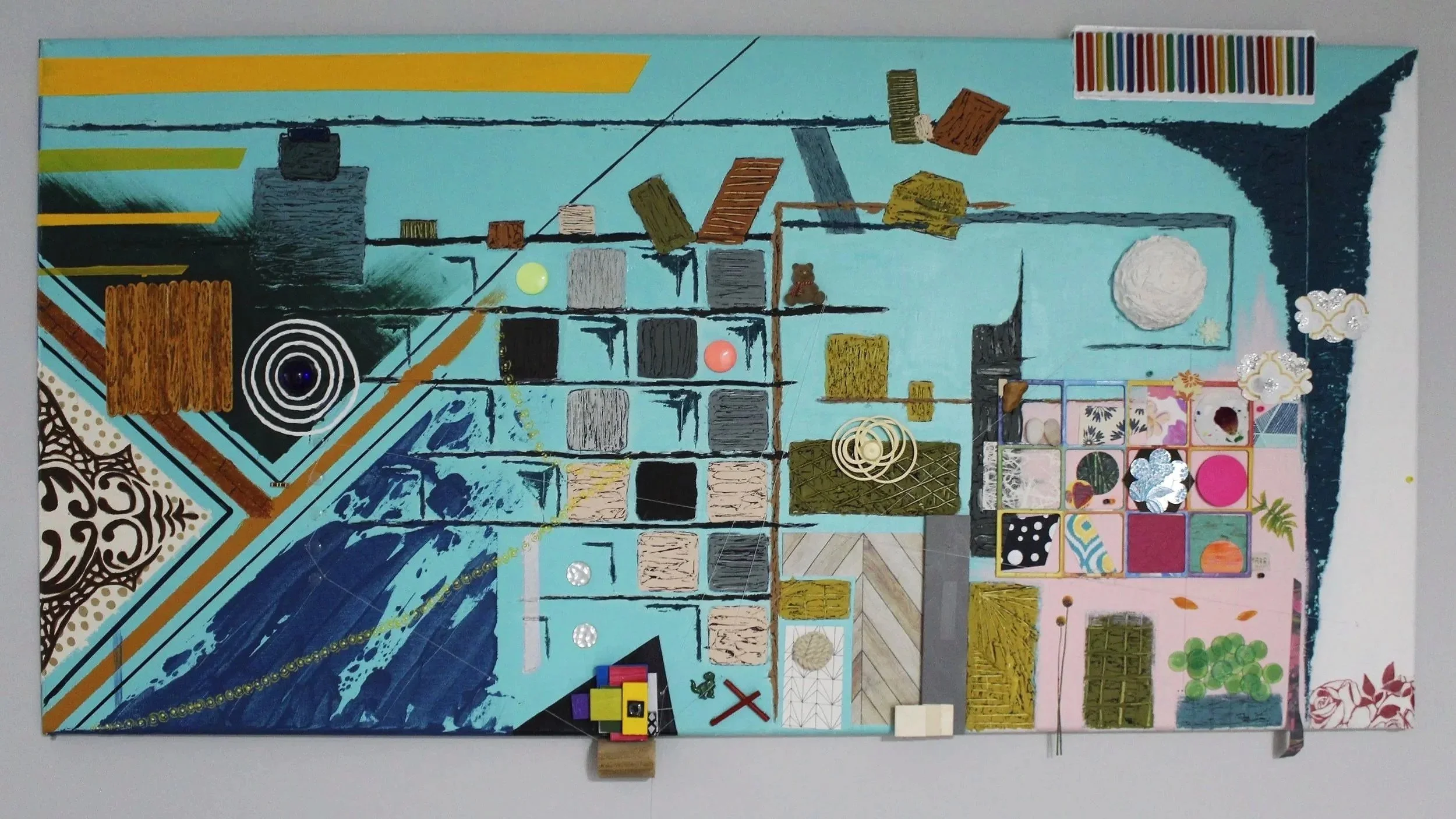
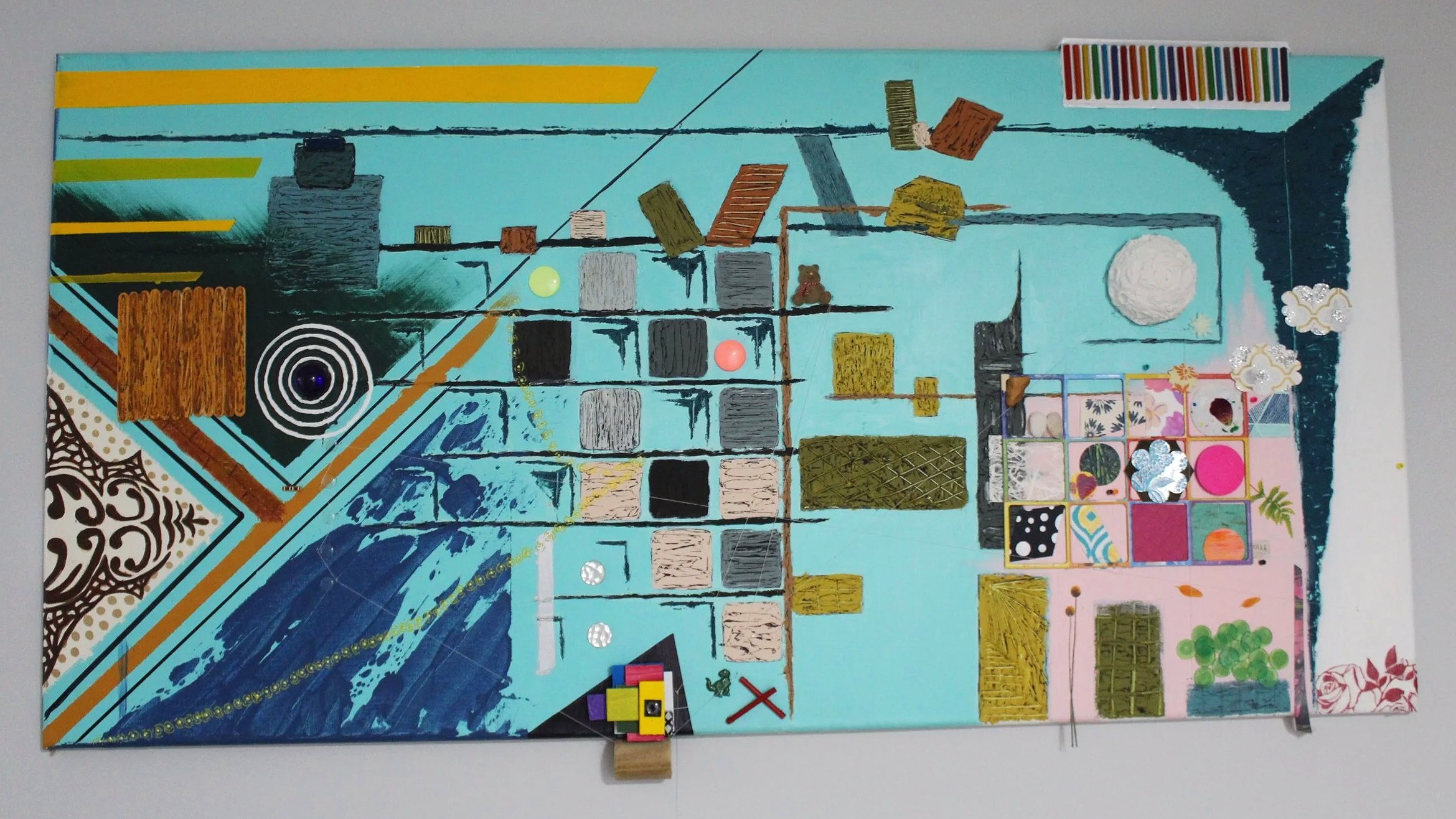
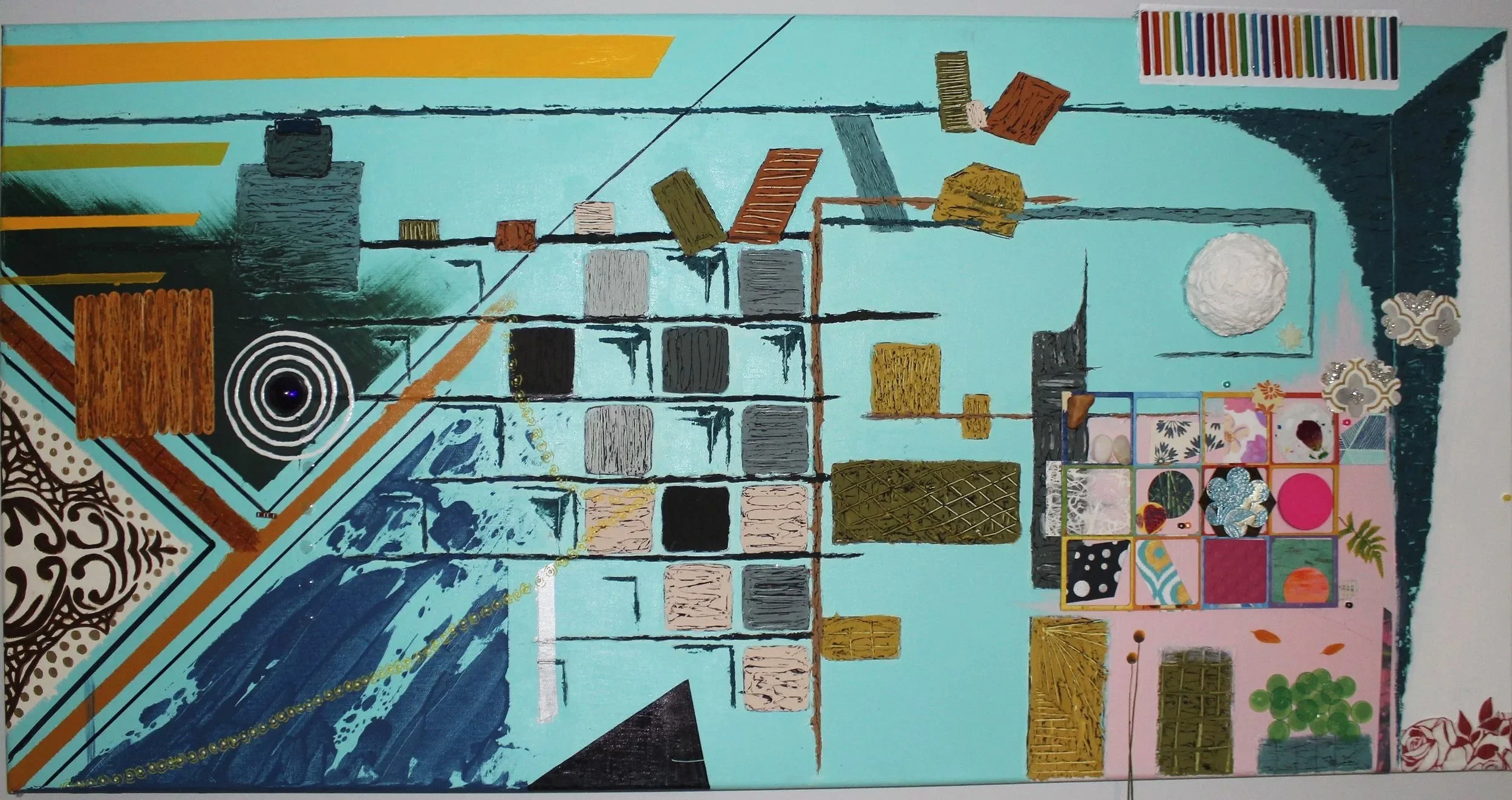
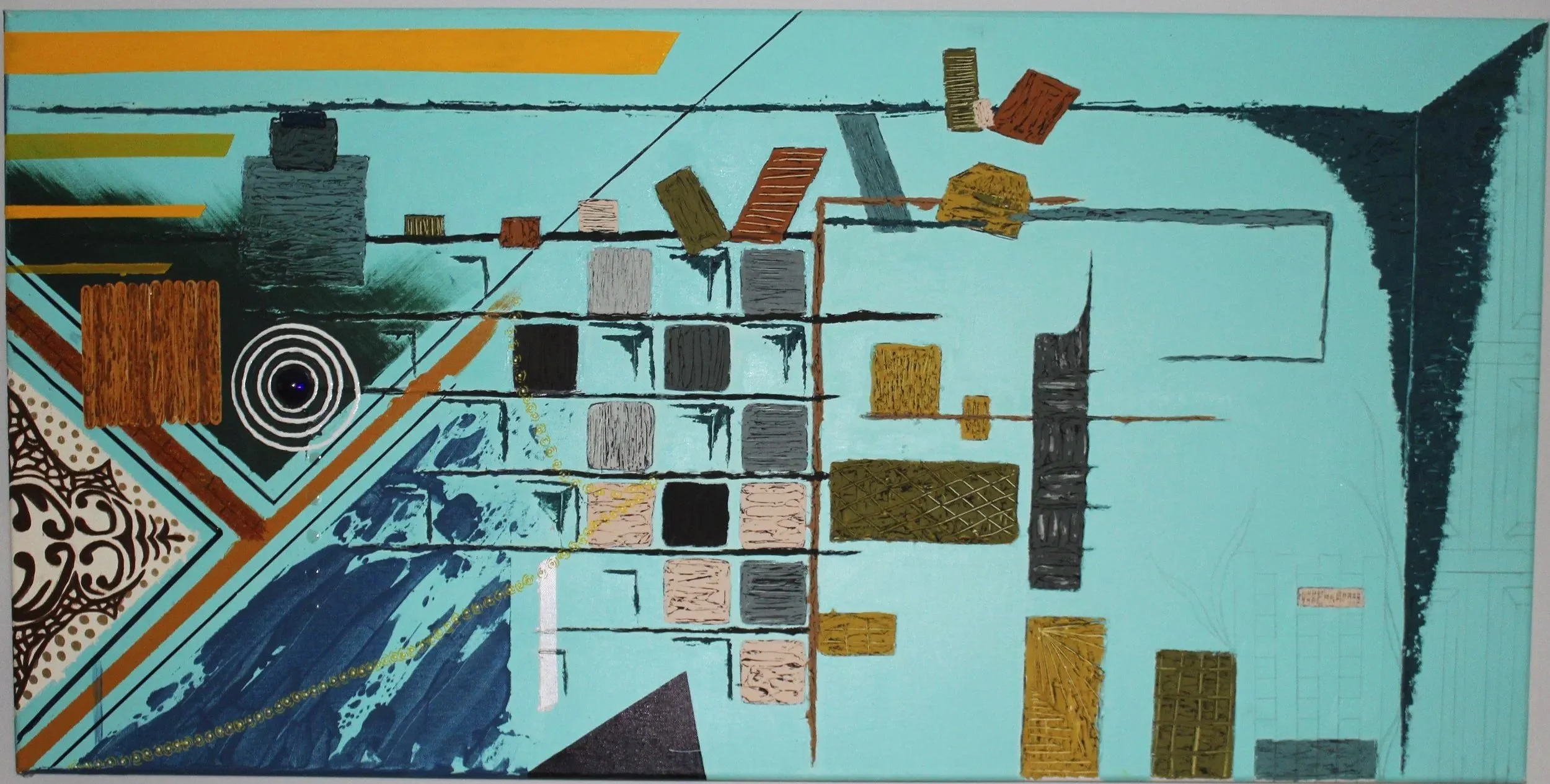
Mommy & Me
Acrylic paint, mixed media and found objects
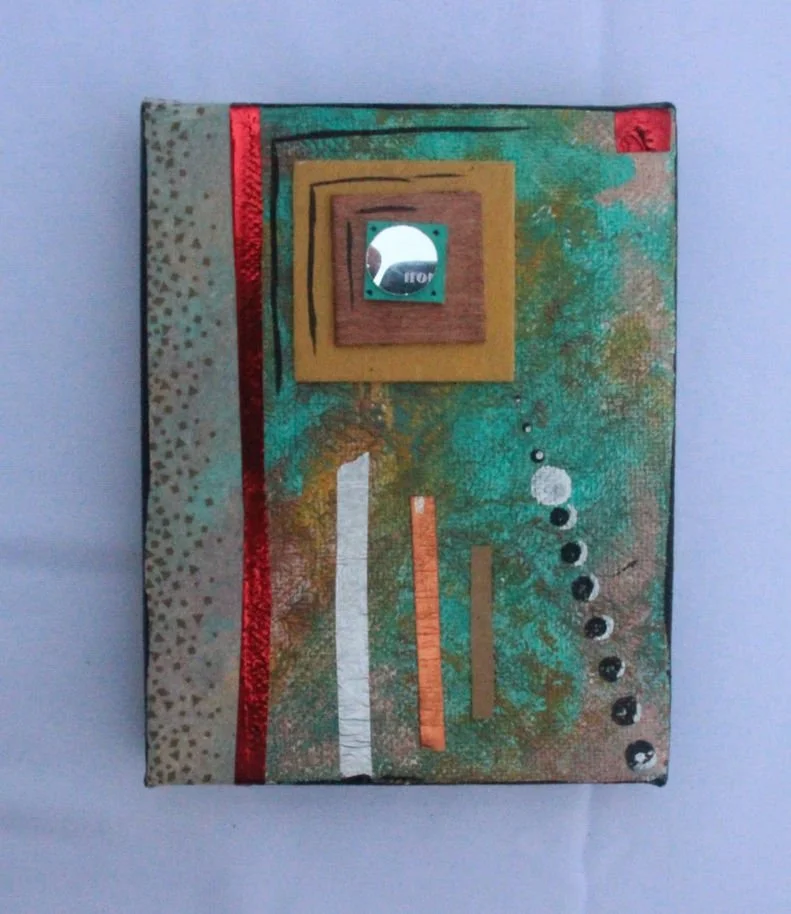
As a young mother, finding a work-life balance while staying motivated as an artist has been a challenge. Between playing with dinosaurs and picking up found treasures, my daughter and I share a deep love for art-making, which has become integral to my practice. Inspired by Brandi Hofer’s collaborative process, I use this creative space to teach shapes, color theory, letters, numbers, and patterns, while embracing a fluid approach that values process over predetermined outcomes. Each piece evolves naturally, revealed when we decide it is complete.
Sustainability is central to our work. We repurpose old canvases, found objects, and thrifted materials—buttons, gems, fabrics, toys—and make paper from leftover scrap. Through this process, my daughter learns storytelling, self-care, and environmental responsibility. This body of work represents a shift to fully collaborative practice, where the interactions and marks of others guide the creation, offering freedom to explore and the challenge of shaping it into meaningful work.
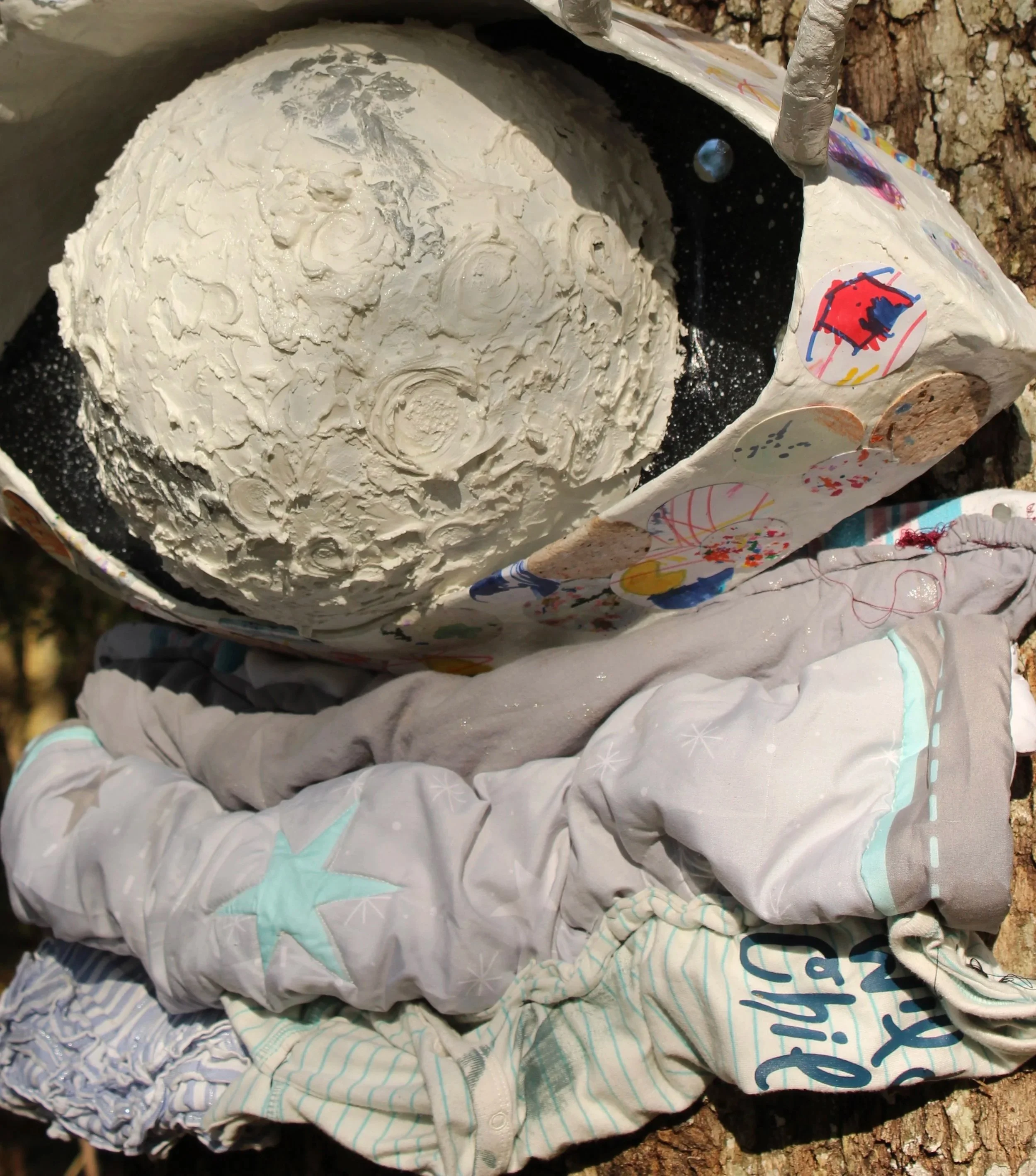
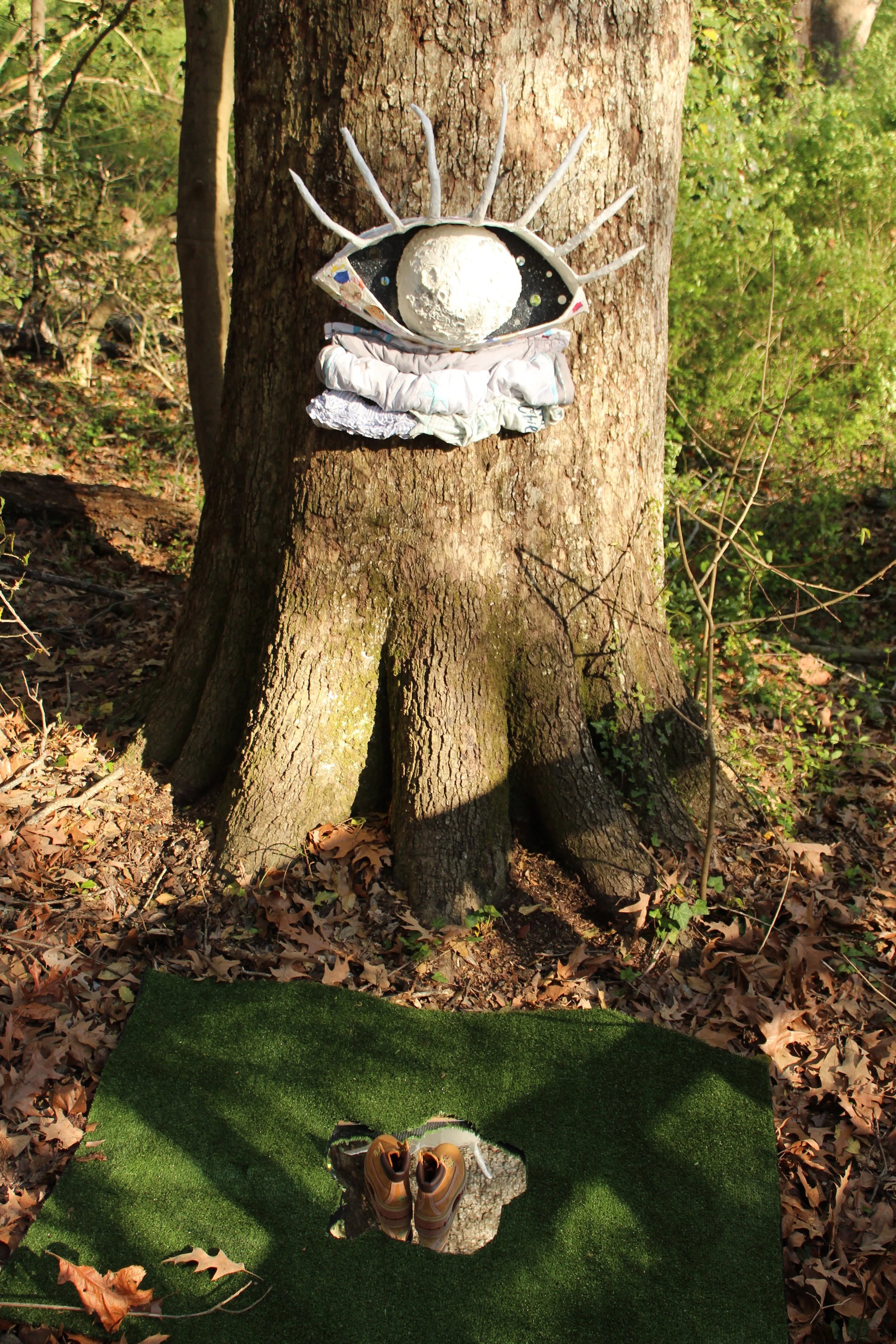
Title: A Mother’s Perspective: , This mixed-media sculptural work takes the form of a large eye—its gaze constructed from circular cutouts of artwork and handmade paper created in collaboration with a child over the course of two years. The piece was inspired by a bedtime story that left her dreaming of leaving her footprints on the moon. Together, they built that moon—textured and luminous—and pressed her small footprints into metallic paint, preserving both imagination and scale in a single gesture. The eye becomes both witness and portal. Within its iris live fragments of a child’s creativity—color, mark-making, experimentation—layered into the mother’s field of vision. The perspective is shared, intertwined. Old blankets and baby clothing are attached beneath the eye, forming heavy, sagging shapes that resemble bags under it—physical manifestations of exhaustion. These fabrics, once sources of warmth and comfort, now carry the weight of sleepless nights and relentless care. They tether tenderness to fatigue. Below the suspended eye rests a square of artificial grass. In its center is a small puddle-shaped hollow holding a pair of empty childhood boots. The boots are not fixed; they change depending on what the child wears at the time of exhibition. This subtle shift allows the work to grow alongside her, refusing to freeze her in a single stage of life. The empty boots stand as imprint and absence—evidence of movement, of grounding, of becoming. The piece holds dreaming and depletion in the same frame. It reflects a mother’s perspective: always watching, always carrying, always imagining further than the present moment.
Title: A Mother’s Perspective: This mixed-media sculptural work takes the form of a large eye—its gaze constructed from circular cutouts of artwork and handmade paper created in collaboration with a child over the course of two years. The piece was inspired by a bedtime story that left her dreaming of leaving her footprints on the moon. Together, they built that moon—textured and luminous—and pressed her small footprints into metallic paint, preserving both imagination and scale in a single gesture. The eye becomes both witness and portal. Within its iris live fragments of a child’s creativity—color, mark-making, experimentation—layered into the mother’s field of vision. The perspective is shared, intertwined. Old blankets and baby clothing are attached beneath the eye, forming heavy, sagging shapes that resemble bags under it—physical manifestations of exhaustion. These fabrics, once sources of warmth and comfort, now carry the weight of sleepless nights and relentless care. They tether tenderness to fatigue. Below the suspended eye rests a square of artificial grass. In its center is a small puddle-shaped hollow holding a pair of empty childhood boots. The boots are not fixed; they change depending on what the child wears at the time of exhibition. This subtle shift allows the work to grow alongside her, refusing to freeze her in a single stage of life. The empty boots stand as imprint and absence—evidence of movement, of grounding, of becoming. The piece holds dreaming and depletion in the same frame. It reflects a mother’s perspective: always watching, always carrying, always imagining further than the present moment.
Title: Evening Vine: Painted live at Port of Leonardtown Winery, Evening Vines captures the vibrant energy of the vineyard at dusk. Created in real time during an interactive painting experience, this piece reflects the connection between community, nature, and celebration. Each brushstroke embodies the collaborative spirit of the event, turning shared moments into a lasting visual memory.
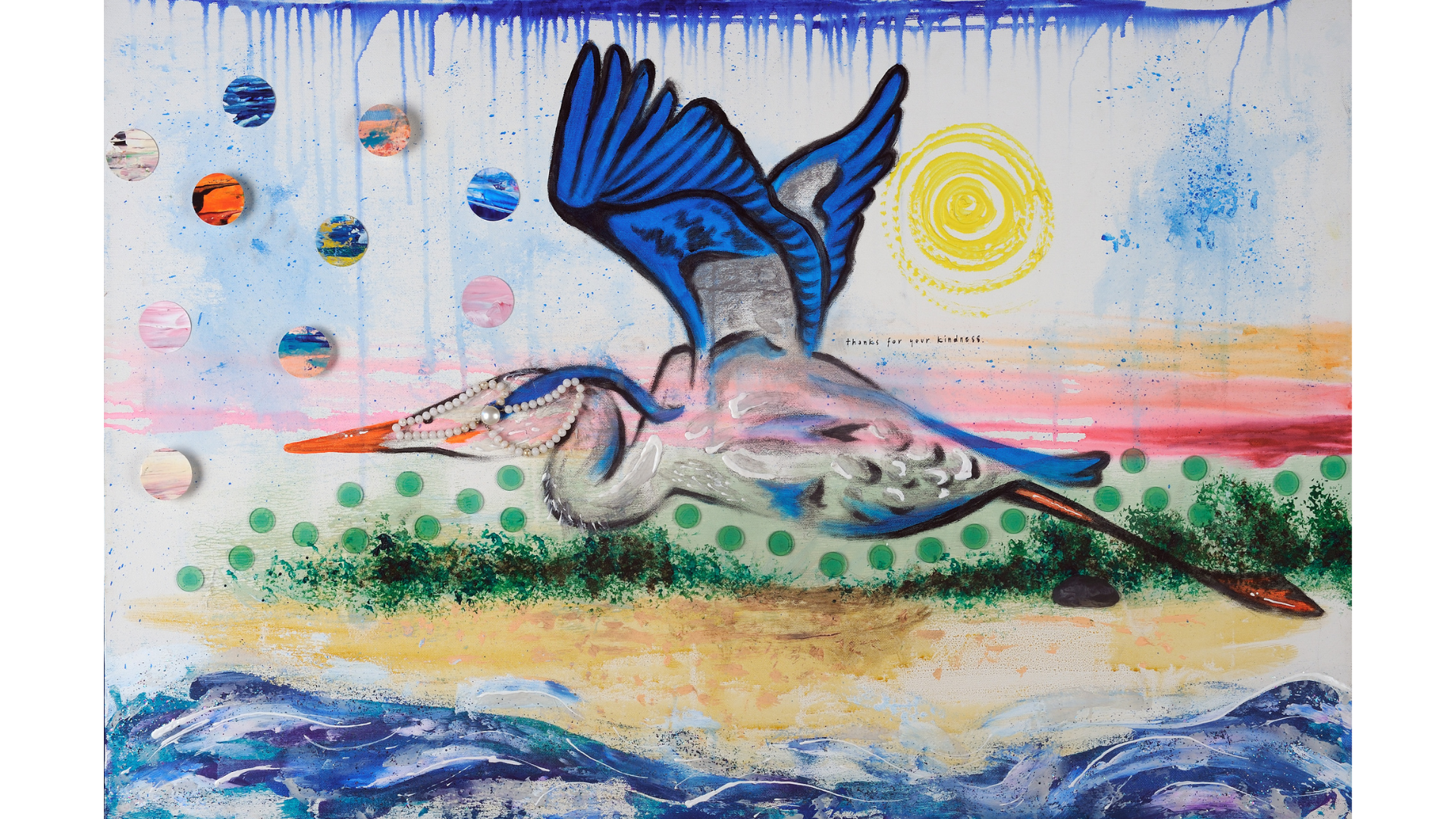
Title: Thank You For Your Kindness: At the center of the piece is a blue heron, a bird often associated with patience, quiet observation, and resilience. Blue herons move slowly and deliberately through their environments, embodying a calm attentiveness that mirrors the pace of process-based art making. Their presence within the work reflects a reminder to slow down, notice the small details around us, and approach both life and creativity with care and intention. The text “thank you for your kindness” appears within the image as a gesture of gratitude—both personal and communal. It acknowledges the generosity, patience, and compassion that make collaborative work possible, especially within the shared creative space between parent and child. The phrase also serves as an offering to the viewer, recognizing the quiet acts of kindness that sustain communities and relationships.
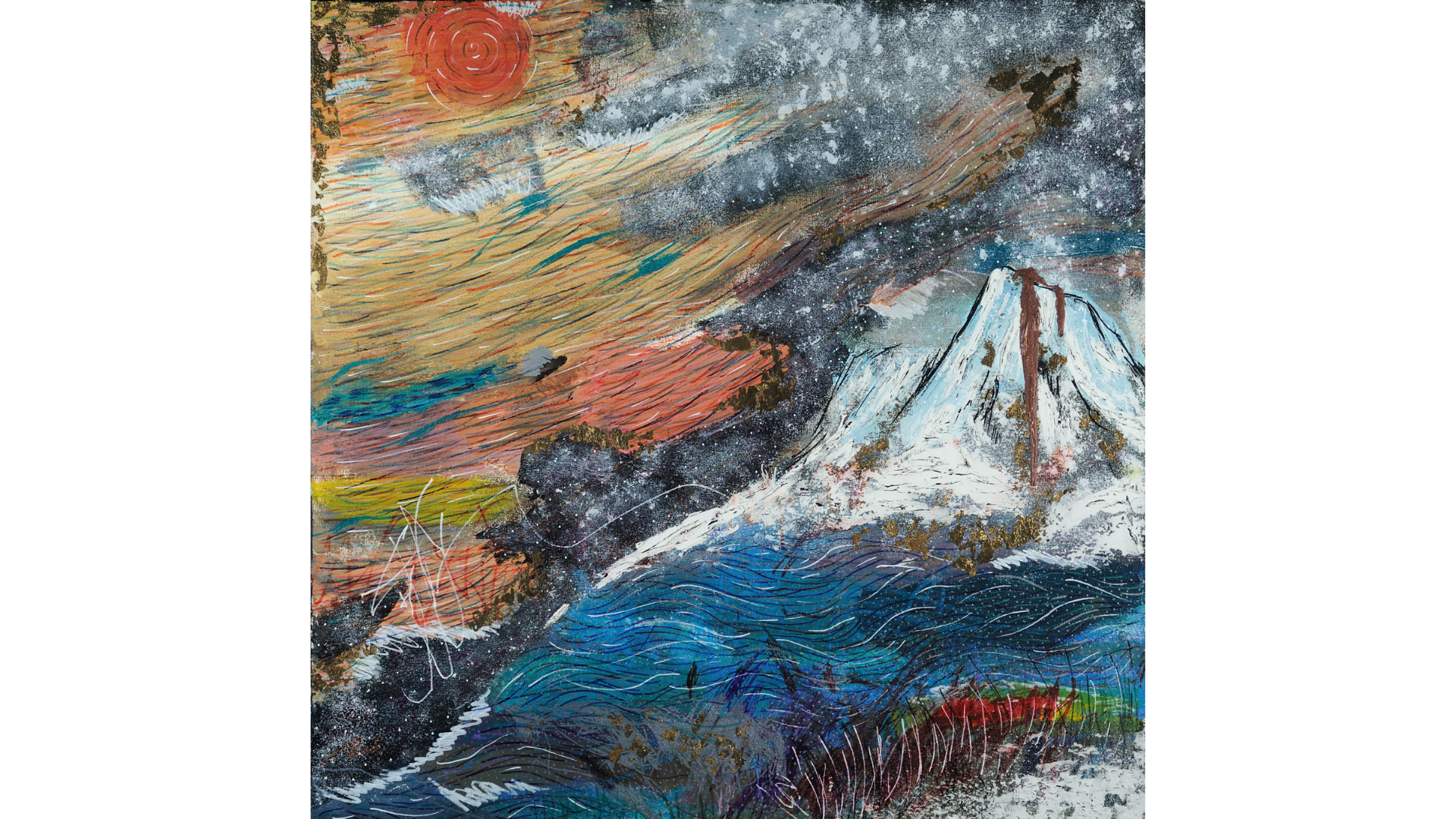
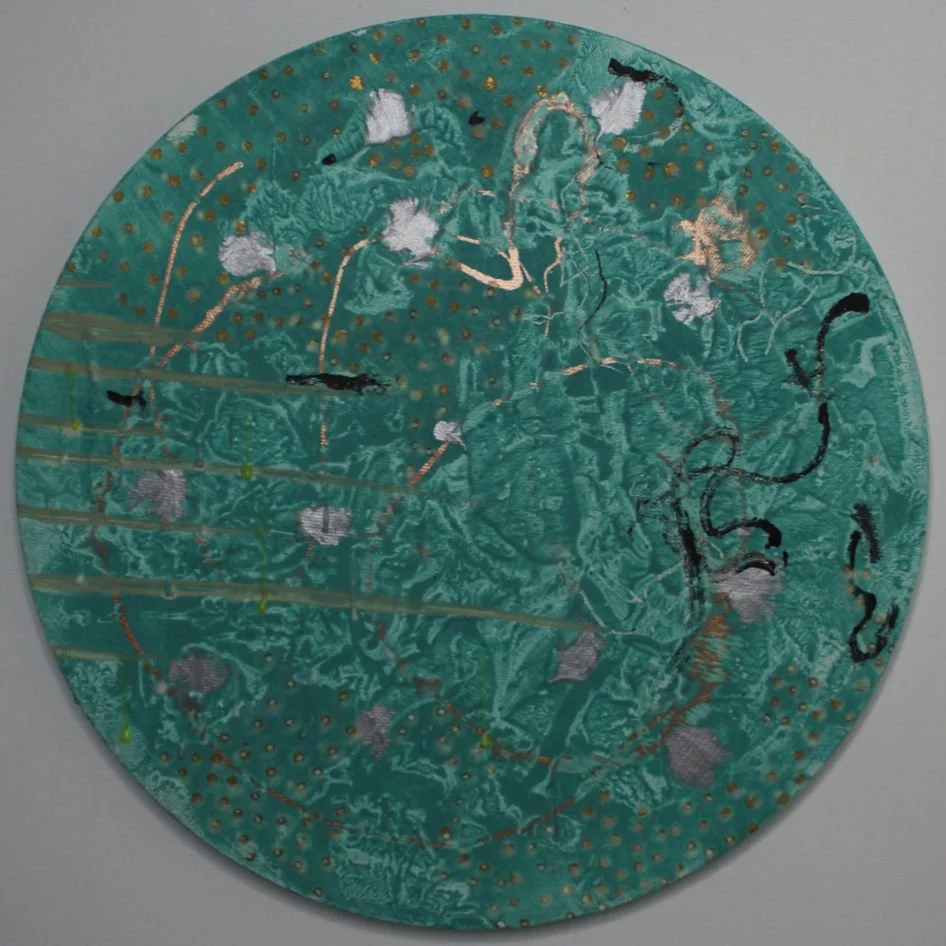
Title: Paradise: Paradise bega:n as an abandoned painting left behind by a former student—its surface covered in smeared paint and unresolved marks. Rather than discarding it, the canvas became the starting point for a new world created through collaboration with my daughter. Together, we studied the existing shapes and textures, allowing our imaginations to interpret what was already there. Through conversation, play, and intuitive mark-making, we transformed the remnants of the original work into a landscape shaped by storytelling and shared discovery. This process reflects my commitment to reuse and transformation—both materially and conceptually. What once felt unfinished or forgotten became an invitation to look closer and imagine new possibilities. The title Paradise speaks to a deeply personal longing: the dream of creating a safe and nurturing world for my child. In this moment of co-creation, the canvas became a space where imagination could flourish freely—a place where we could build something together that felt joyful, protective, and full of wonder. The painting stands as both a reimagined landscape and a quiet reflection of a parent’s hope to create a paradise where their child feels safe, seen, and free to explore.
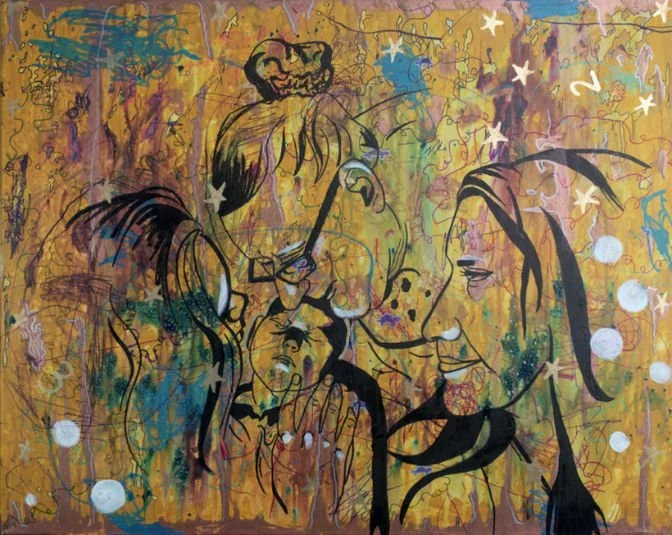
Title: Generational II: Building on the experiences and memories of the original Generational piece, this work expands the collaboration to include my mother, my grandmother, and my daughter. Together, we created a layered, intuitive painting that emphasizes connection over outcome. Each mark and gesture serves as a memory, a moment of shared presence, and a celebration of family bonds. The process allowed us to honor the lineage of creativity, bridging generations through paint and play. Inspired by previous sessions with my grandmother, this work becomes both a continuation and an evolution—a living record of familial love, shared storytelling, and the enduring power of art to preserve connection across time.
Title: Generational: Created as a collaborative exploration with my daughter and my grandmother on my father’s side. My grandmother lived with dementia and often could not recall who we were, yet our shared paint sessions remained a constant source of connection and joy. Together, we approached the canvas without concern for a final image, focusing instead on the act of creation as a way to communicate, remember, and engage with one another. The Generational series reflects the layers of family, memory, and presence. Each mark, color choice, and brushstroke becomes a record of interaction—a tangible trace of connection with a part of my grandmother I feared I had lost. Through collaboration across three generations, these works celebrate the enduring power of art to bridge time, preserve relationships, and honor both memory and imagination.
Title: Out First Masterpiece: I began painting with my daughter when she was just five months old, finding creative ways to incorporate her into my artistic process. Early experiments included placing canvas in a bag or wrapping it in foil with paint for her to smash, offering her markers and using whichever one she selected, or letting her roll dice that corresponded to predetermined shapes and patterns. This piece represents our first true collaborative creation—a moment where play, intuition, and experimentation guided the outcome. It captures the beginning of a lifelong shared practice, emphasizing process over perfection and establishing a foundation for co-creation, exploration, and connection that continues to shape my work today.
Coping as a Caesarean Mother
Acrylic paint, mixed media and found objects
This body of work explores reconstructed memories and the physical, emotional, and spiritual responses shaped by my experiences as a genderqueer mother. Inspired by Mary Cassatt and Judy Chicago, I address the realities of pregnancy, birth, and motherhood through a genderqueer lens, while Louise Bourgeois influenced my use of found objects to convey pain, discomfort, and insecurity.
I employ layers, texture, color, and geometric shapes to translate space and time, drawing from Carrie Patterson’s work, and integrate collaboration and motherhood into the creative process, as inspired by Brandi Hofer. Including my child in the studio allowed art to become both a bonding experience and a coping mechanism, fostering reflection, self-awareness, and acceptance.
This series primarily consists of textured acrylic paintings combined with found objects from my postnatal period. It marks a shift toward sculptural and abstract forms, enabling me to explore complex, deeply personal themes that were difficult to express verbally.
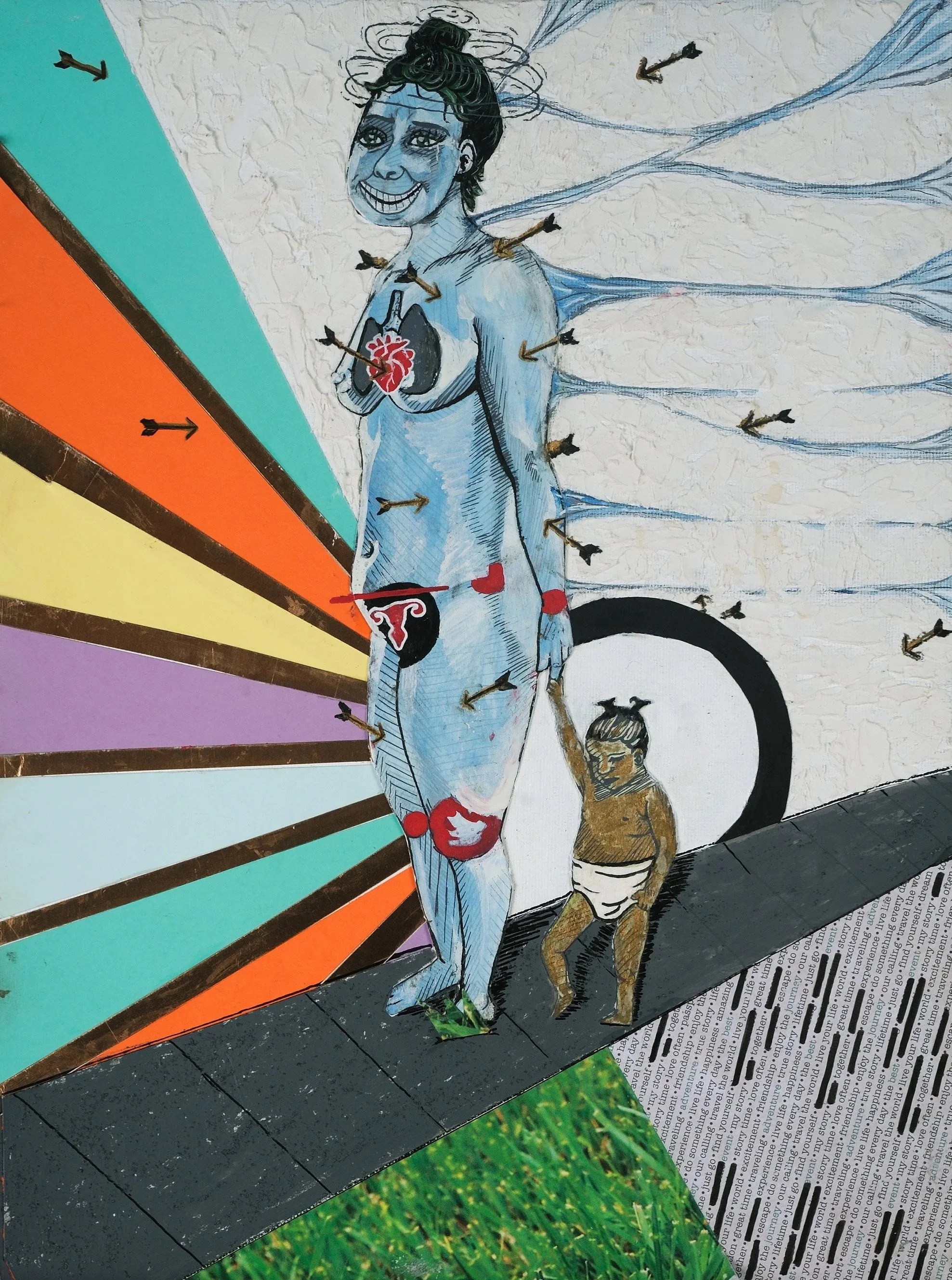
Title: With Every Blow: With Every Blow is a layered collage exposing the vulnerability of motherhood in both body and spirit. A woman’s naked figure stands with her heart, uterus, and joints revealed in red—organs and connection points laid bare, emphasizing the physical and emotional toll carried within them. The exposure is intentional: she is unarmored, transparent, and open. She holds her child’s hand as they walk toward an expanse of color and green grass—a symbol of hope, growth, and possibility. Yet behind the mother trails a thick white textured mass intertwined with string, tugging backward. The strings suggest invisible forces—circumstance, expectation, generational weight—attempting to restrain forward movement. Beneath their feet, the ground is layered with redacted words—fragments of lived experience partially concealed, partially obscured. These silenced narratives form the terrain they walk on: histories edited, misunderstood, or judged. Arrows descend from all directions, piercing the woman’s skin. Criticism, pressure, fear, and expectation land squarely on her body. A shield surrounds the child as they move forward, untouched. The impact is absorbed by the mother, whose role becomes both passage and protection. Despite the assault, she bears a painful smile—fixed and unwavering—even as her head spins from the force of it all. The smile speaks to endurance, to the performance of strength when disoriented and overwhelmed. With Every Blow captures the quiet resilience of a woman who continues forward, absorbing what she must so her child can walk freely toward color.
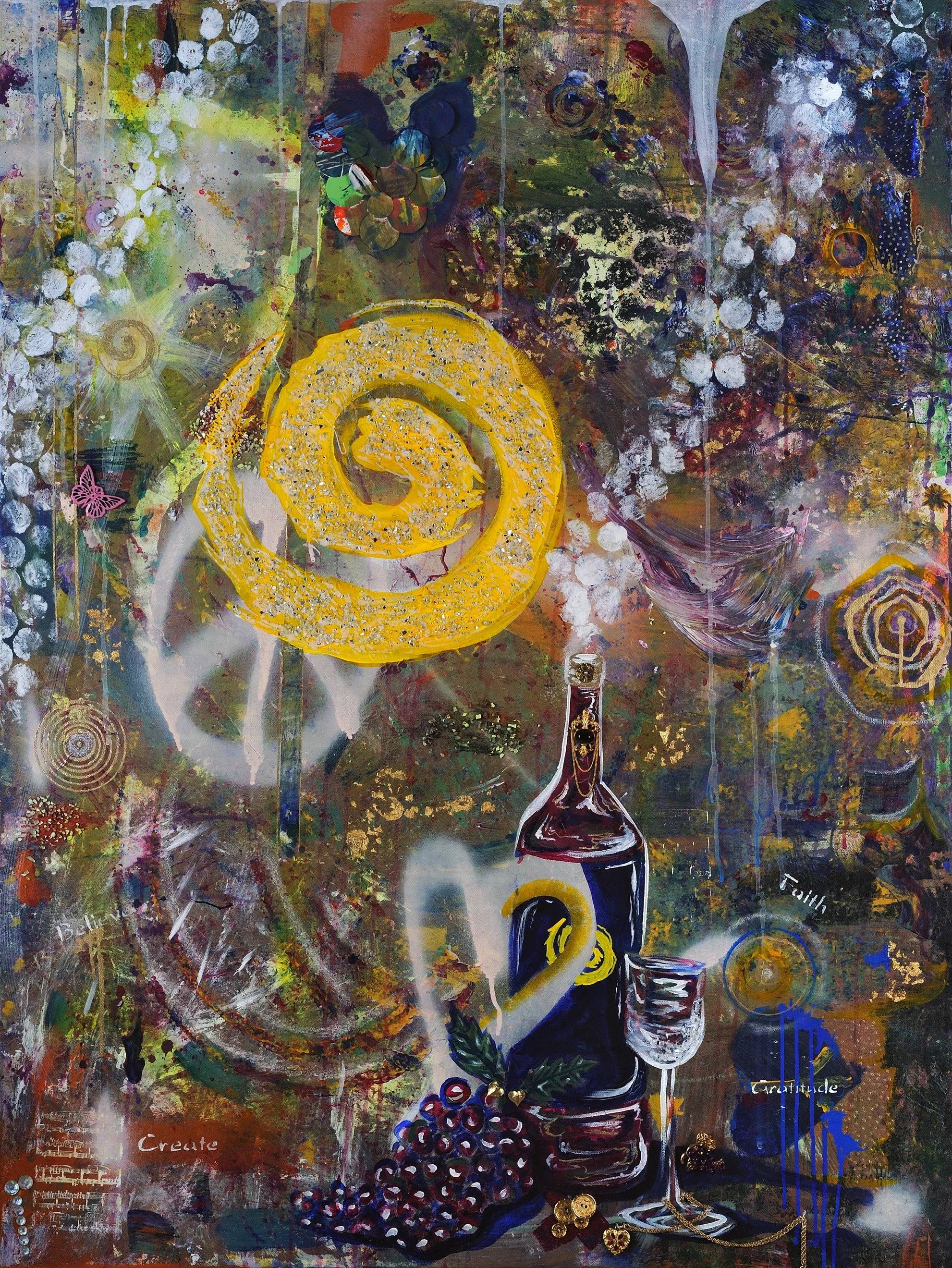
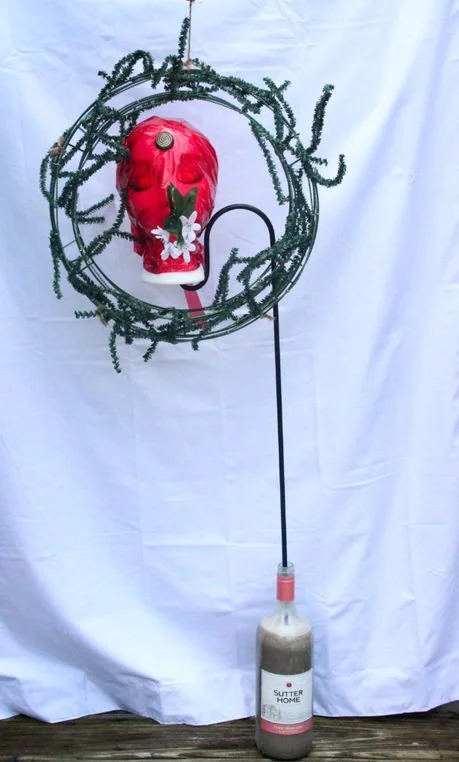
Title: Coriander: An empty wine bottle, hardened with cement, becomes the body of this piece—heavy, sealed, and immovable. From it rises a foam head wrapped tightly in red cellophane, its surface suffocated in a translucent veil. A wreath encircles the form, while delicate coriander flowers protrude from the mouth, blooming where breath should be. Coriander flowers, long associated with lust and desire, emerge as both confession and confrontation. Their softness contrasts with the rigidity of cement and the artificial glare of cellophane. The wine bottle—once a vessel of indulgence—now stands immobilized, its emptiness preserved in stone. Together, the wine and cement symbolize a period in which I felt myself sinking into misguided choices and restless attempts to reclaim identity—to feel like a person again beyond motherhood, beyond responsibility. The red wrapping suggests heat, impulse, and suffocation all at once. It obscures the face, muting expression, while the flowers press outward from the mouth as if desire itself cannot be contained. The wreath frames the head like a halo or memorial, hinting at cycles—of longing, regret, and self-reflection. Coriander holds the tension between hunger and restraint, pleasure and consequence. It speaks to the moments when desire feels like oxygen, yet leaves you breathless. It is an artifact of drowning and awakening—of recognizing how easily the search for self can harden into something that traps you, even as you try to bloom.
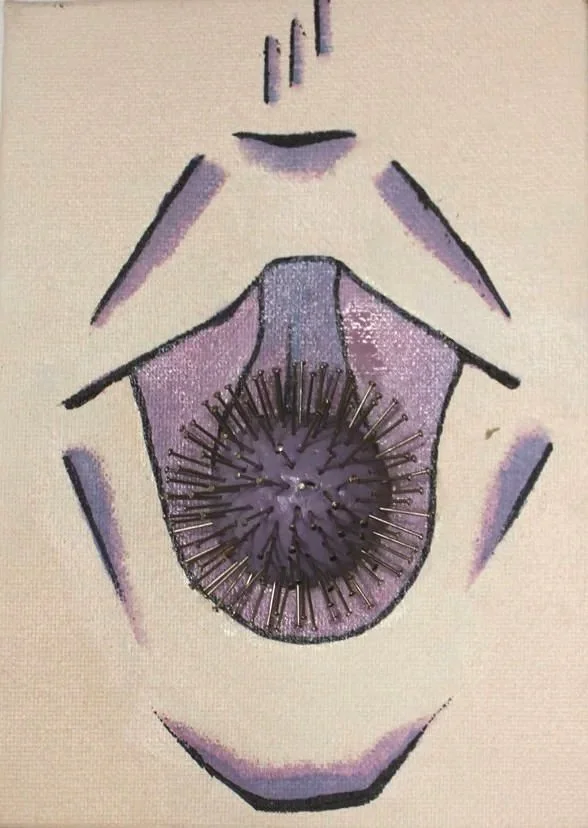
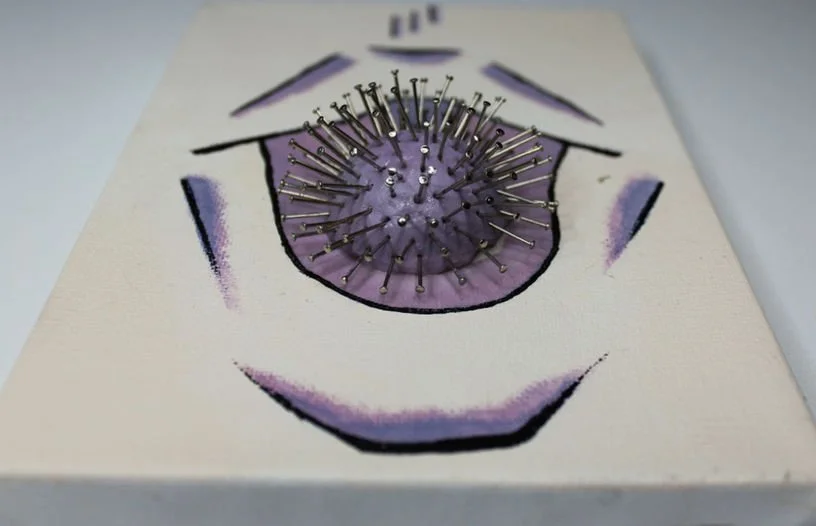
Title: Breast Feeding: Breast Feeding is an abstracted mouth—open, exposed, and vulnerable. At its center, a foam ball stands in as the nipple, soft in form yet surrounded by protruding nails. The contrast between yielding and piercing materials reflects the duality of my breastfeeding experience: nourishment and pain existing at the same time. This piece centers on the physical and emotional sensations that defined that season. The raw tenderness. The sharp, startling pain of each latch. The flinching of my body bracing itself before contact. What is culturally framed as natural and instinctive felt, for me, jagged and overwhelming. My body felt both demanded and misunderstood—expected to provide seamlessly while internally resisting. The mouth form suggests hunger, dependency, and urgency, while the nails speak to the invisible spikes of anxiety, guilt, and pressure I carried. I remember the heat in my chest, the ache that radiated through my shoulders and back, the way my breath would shorten as I prepared myself mentally to endure another attempt. There were moments of closeness, yes—but they were often overshadowed by tension and fear of not being enough. This work does not reject breastfeeding; it questions the silence surrounding its difficulty. It holds the complexity of feeding a child while feeling physically invaded, emotionally fragile, and painfully exposed. Breast Feeding makes visible the sharp edges within an experience so often romanticized—honoring both the softness and the sting.
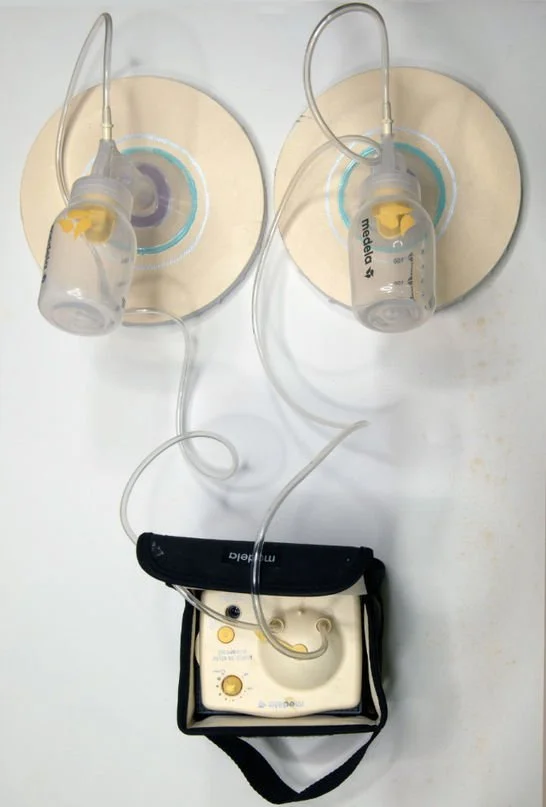
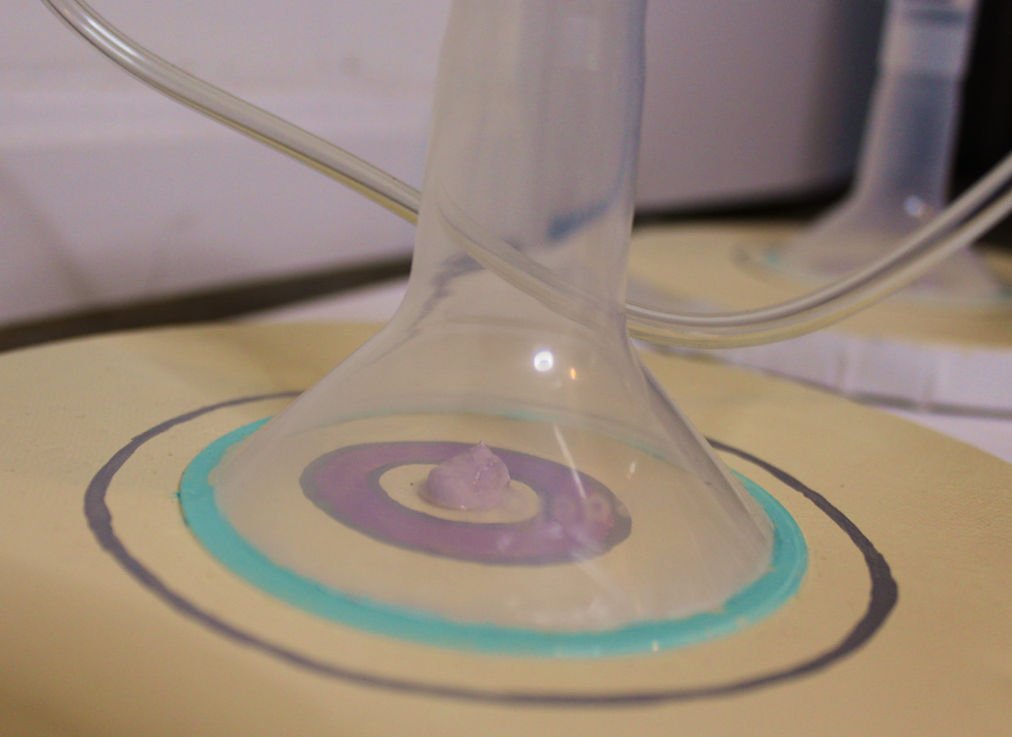
Title: Breast Pump: Breast Pump is a deeply personal work incorporating acrylic paint, modeling paste, and the Moderna breast pump from my own motherhood journey. The physical presence of the pump transforms the canvas into both artifact and confession—evidence of a season marked by exhaustion, pressure, and self-doubt. This piece reflects my struggle with breastfeeding and the profound sense of failure I carried when my body did not respond the way I believed it was meant to. I struggled to produce. I struggled to get her to latch. In that struggle, I began to feel disconnected—not only from my child, but from myself. What should have been an intimate bond became entangled with shame and inadequacy. The theme of “struggling to produce” echoes throughout my broader body of work, symbolizing both physical and creative depletion. When I returned to work as a server, pumping became another source of stress. Double shifts and tables depending on me left little room for the breaks my body required. The practical demands of survival overrode intention, and eventually, I gave up—not from lack of love, but from lack of support and sustainability. Through texture and tension, Breast Pump confronts the quiet pressures placed on mothers—the expectation that the body will perform, nurture, and provide without interruption. It honors the unseen labor, the private grief, and the resilience that persists even in perceived failure.
Title: Collided Space VI: This layer reflects the period when I returned to live closer to my daughter’s father and the community I loved and valued. Although the space was a small, cramped one-bedroom basement apartment, it carried a profound sense of pride and accomplishment. As a disabled single mother supporting my child on my own, this layer embodies resilience, determination, and independence. The textures, marks, and overlapping forms capture both the physical constraints of the space and the emotional richness of creating a home filled with care, love, and persistence. It is a visual testament to strength, resourcefulness, and the quiet victories of daily life.
Title: Collided Space V: This layer reflects the period following my father’s passing, when my family and I lived together under one roof. The experience was intense and overwhelming, leaving us feeling smothered and suffocated. Thin, overlapping lines and fragmented shapes represent the way everyone was stacked on top of one another, with past trauma and unresolved tensions constantly resurfacing. The marks in this layer capture the emotional density of the household, the struggle for space—both physical and emotional—and the darkness of that time. It serves as a visual record of complexity, tension, and the challenging process of navigating grief and intergenerational dynamics within shared spaces.
Title: Collided Space IV: This layer reflects the time after quarantine struck, when financial challenges led her father, another adult, and I to move in together. Each of us had our own floor, while communal spaces were shared, creating a dynamic household full of both independence and interaction. Surrounded by water, nature, and parks—and located near Annmarie Gardens, which we visited often—this space nurtured new experiences and exploration. It is also where my daughter began to expand her interests and discovered her love for pink. In this layer, I incorporated references to our nature walks, time spent outdoors, and shared moments of wonder, translating the energy of this vibrant environment into texture, color, and layered imagery.
Title: Collided Space III: This layer reflects the period when I came to stay with my grandmother, who suffered from dementia, and I became her full-time caretaker. The work is bittersweet, carrying the weight of saying goodbye to a home that shaped our family and a space my daughter would grow up in but eventually forget, along with those who no longer lived there. I incorporated trinkets I had held onto for over twenty years, many kept at my grandmother’s home and rediscovered during this time. The marks and textures reference the unique patterns of old tiles and painted windows, as well as the slivers of light that filtered through the space. Through this layer, I sought to capture both memory and presence—a record of domestic life, connection, and the emotional resonance of a home steeped in personal history.
Title: Collided Space II: This layer reflects the first home I purchased and renovated at age 22—a small, imperfect space that nonetheless filled me with pride and independence. The marks and abstract forms capture our shared room, including the twinkle lights we hung above, which brought warmth and magic to an otherwise modest space. This portion of the canvas wasn’t touched until after I had moved out, when I took the time to reflect on my life there. It was in that moment of reflection that I decided to use this piece as a living archive, documenting our moves, experiences, and growth through layered mark-making and the accumulation of personal objects.
Title: Collided Space: Collided Space began as a sparse, minimal composition stretched across a large canvas—an abstract reflection of the room I brought my daughter home to from the hospital as a single mother. The emptiness of the surface mirrored how small, lost, and uncertain I felt in that season of life. Created using leftover household paint from my first home, the materials themselves hold history. As life unfolded and we faced personal hardships that required us to relocate multiple times, the once-bare canvas evolved. With each move, I added layers—string, toys, jewelry, found objects, and sentimental trinkets I’ve carried since my own childhood, many from the time we lived with my grandmother. The composition became denser, more intertwined, as our belongings once did—blending together in shared space as I struggled to maintain control while building stability for us both. What began as a quiet meditation on isolation transformed into a textured archive of resilience, memory, and accumulated experience. This piece holds our movement, our growth, and the beauty that can emerge when fragmented spaces—and lives—collide.
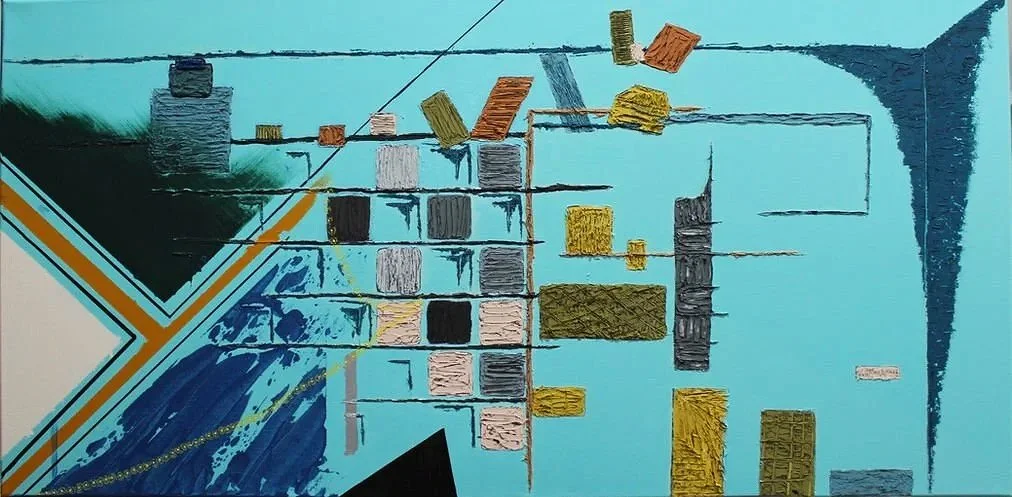
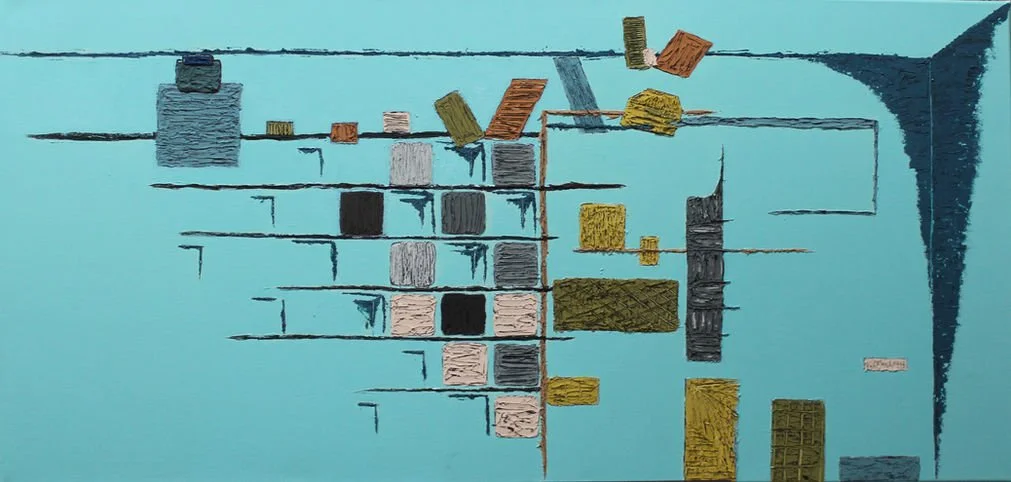
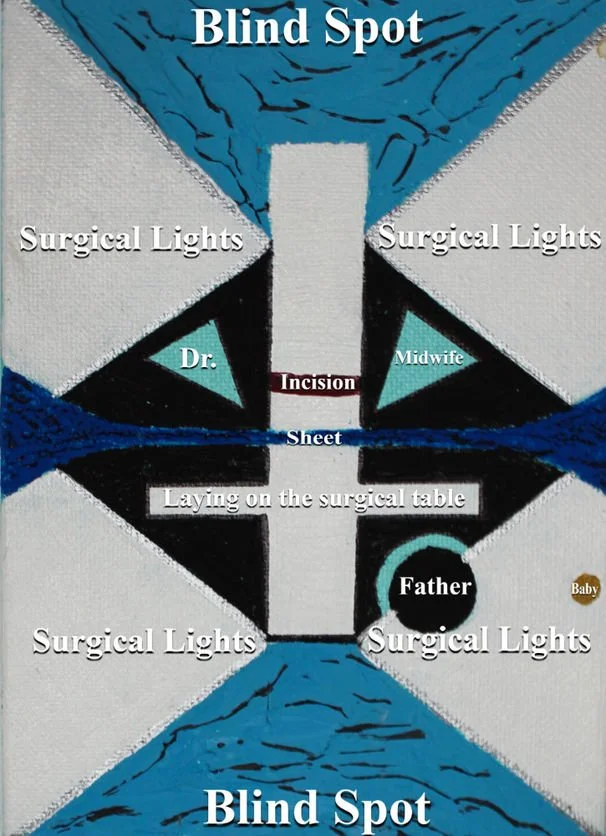
Title: Delivery: Delivery is an abstract reflection of my childbirth experience—one that diverged sharply from what I had envisioned and carefully prepared for. What was meant to be grounded, intimate, and embodied instead felt rushed, jagged, and edged with danger. Being told that both my life and my child’s life could be at risk fractured the moment into something clinical and urgent. The composition mirrors that rupture. Sharp lines, stark contrasts, and intrusive light forms evoke the bright surgical beams I stared into while lying on the table, surrounded by curtains that felt more like barriers than protection. I remember feeling disconnected from my body—no longer sensing contractions or movement—suspended in a space where time seemed both accelerated and absent. Beside me sat someone I barely knew, holding my hand in a moment that should have been deeply personal, yet felt profoundly unfamiliar. There was no space to process. No time to feel. I did not immediately see or touch my daughter. Instead, I was isolated in a recovery room for monitoring, separated from her in the first hours of her life. That distance carved an ache I could not articulate—an overwhelming blend of fear, relief, grief, and loss for the experience I had imagined. Delivery holds that emotional collision. It speaks to disconnection and survival, to the silence that can follow trauma, and to the invisible space between expectation and reality.
Diary of a Pregnant “Woman”
Marker and Watercolor Paint
This body of work, created in 2019, marks a shift from sharing others’ voices to expressing my own. I focus on translating my personal responses to physical and emotional trauma, documenting the doubt, fear, and conflicted feelings I experienced during my pregnancy. My work became a visual diary, chronicling both my physical experiences and mental state throughout the three trimesters.
Influenced by Frida Kahlo’s self-portraiture, I explore identity, trauma, and the human body, while my style draws from Judy Chicago’s ability to convey physical experience—such as childbirth—through color, contrast, and repetition. Barbara Kruger’s text-based art inspired my use of confessional writing and informed my attention to balance, space, and synchronicity within the diary. Primarily executed in markers, this medium allowed me to capture these intimate experiences on the go, between work, college, appointments, and home.
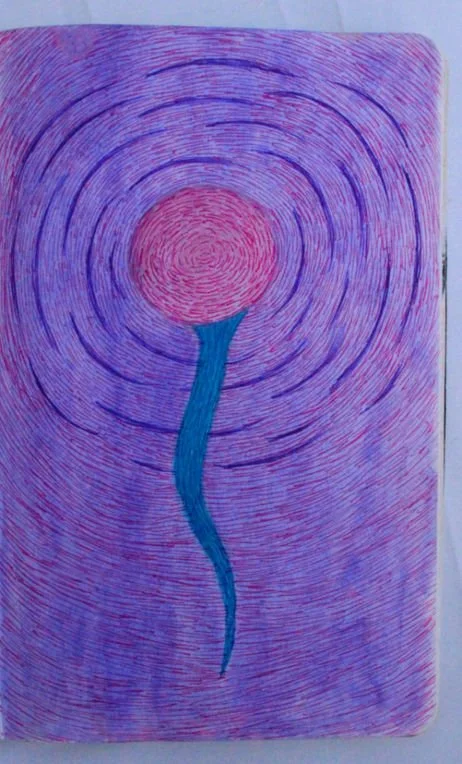
Title: Conception: Conception features obsessive, repetitive mark-making that became a therapeutic process—tracing the intensity, anticipation, and emotional rhythms of pregnancy through abstract gesture.
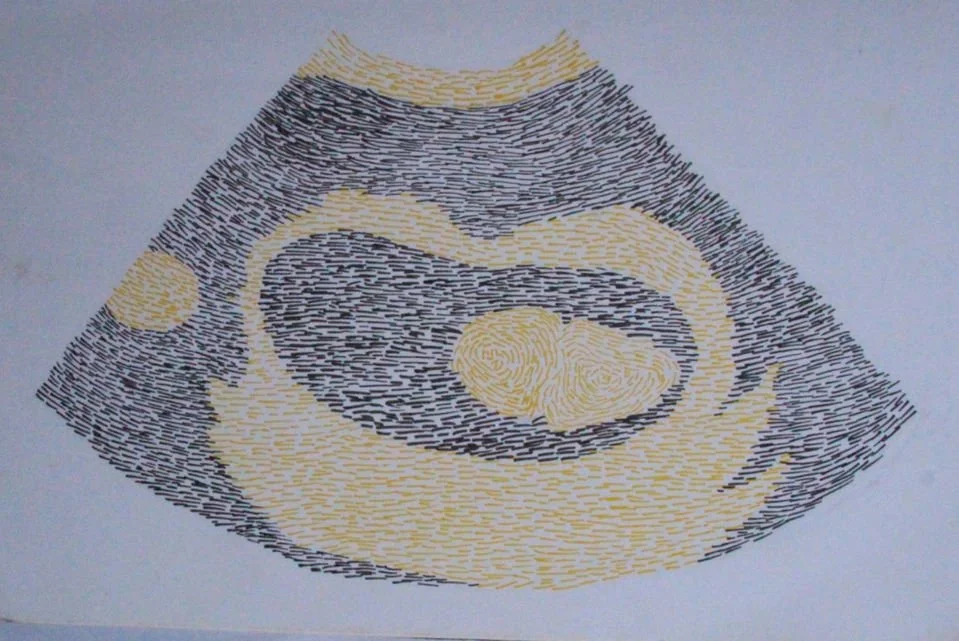
Title: Lil Honeybee: Lil Honeybee continues the therapeutic, obsessive mark-making process of Diary of a Pregnant “Woman”. Using yellow and black, the piece traces over the first sonogram of my child—then just a tiny, indistinct form. Choosing to keep the gender unknown, I referred to her as my “lil honeybee,” a name that became symbolic over time. The repetitive marks transform uncertainty and anticipation into a meditative, intimate record of early connection, capturing the wonder, fragility, and emerging identity of new life.
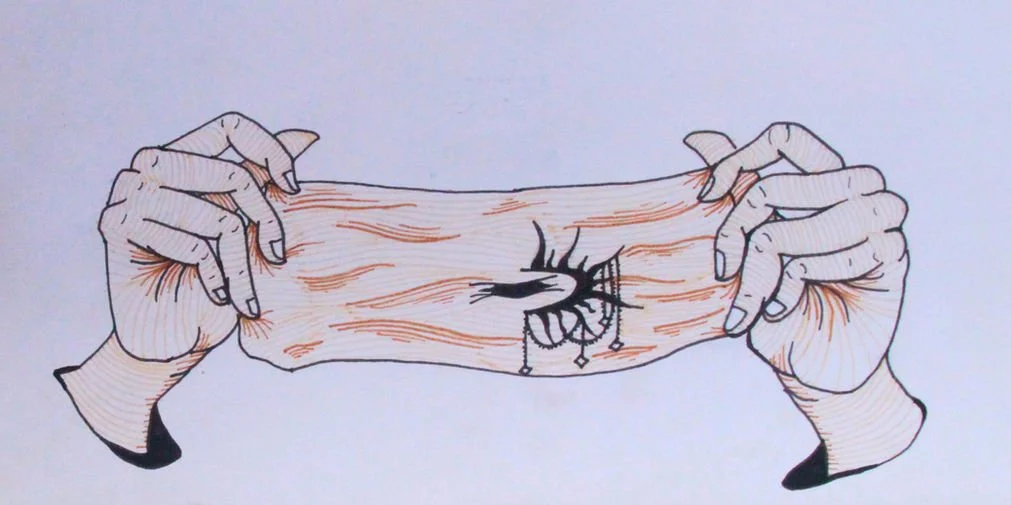
Title: Stretched: Stretched continues the therapeutic, obsessive mark-making process of Diary of a Pregnant “Woman”. The image depicts two hands holding my own stomach, revealing my tattoos, stretch marks, and skin stretched to its limits during pregnancy. The tattoos serve as personal markers of identity and memory, grounding the transformation in my lived experience. Through repetitive marks, the piece reflects vulnerability, physical change, and the intensity of embodiment—honoring both my body’s endurance and the deeply intimate process of carrying new life.
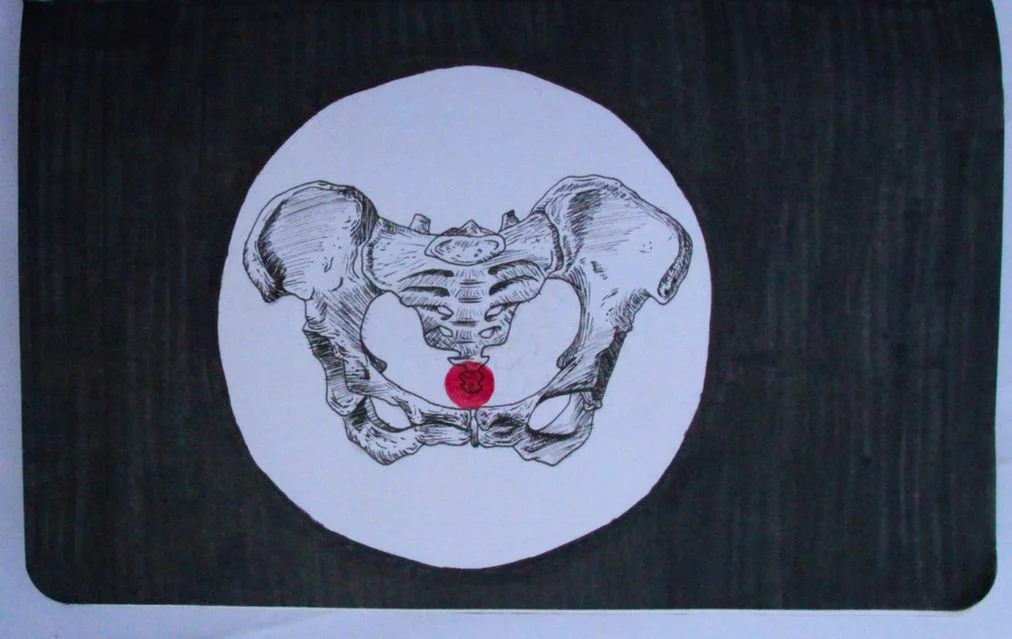
Title: Red Point: Red Point continues the obsessive, therapeutic mark-making of Diary of a Pregnant “Woman”. Rendered entirely in black and white, the piece centers on a circular depiction of female hip bones, symbolizing structure, strength, and vulnerability. A single red spot marks a place of intense pelvic pain, drawing attention to the physical strain and hidden discomfort of pregnancy. The repetitive marks surrounding the circle echo tension, endurance, and the ongoing negotiation between body, sensation, and experience.
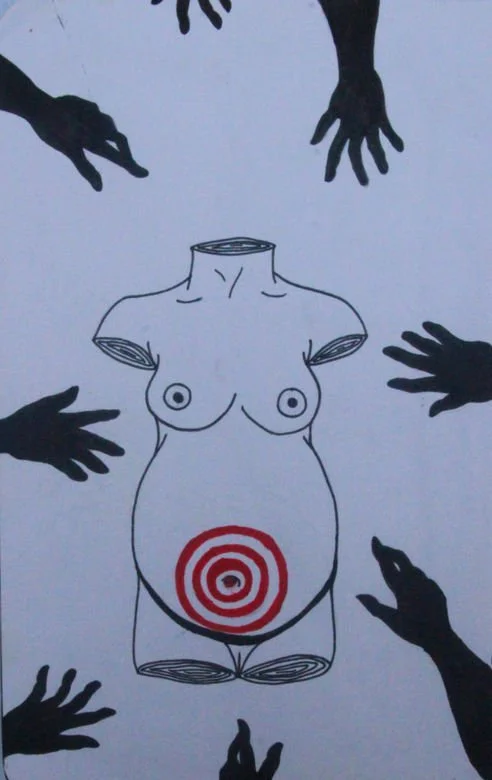
Title: We Are Human: We Are Human is a commentary on the erasure and objectification often experienced during pregnancy. The piece features repetitive figures of hands reaching out, symbolizing the external pressures, expectations, and invasions felt by pregnant individuals. Through the repetition of these reaching hands, it conveys the sense of being reduced to a body for reproduction, highlighting the loss of individuality and the struggle to maintain a sense of self and humanity amid societal scrutiny.
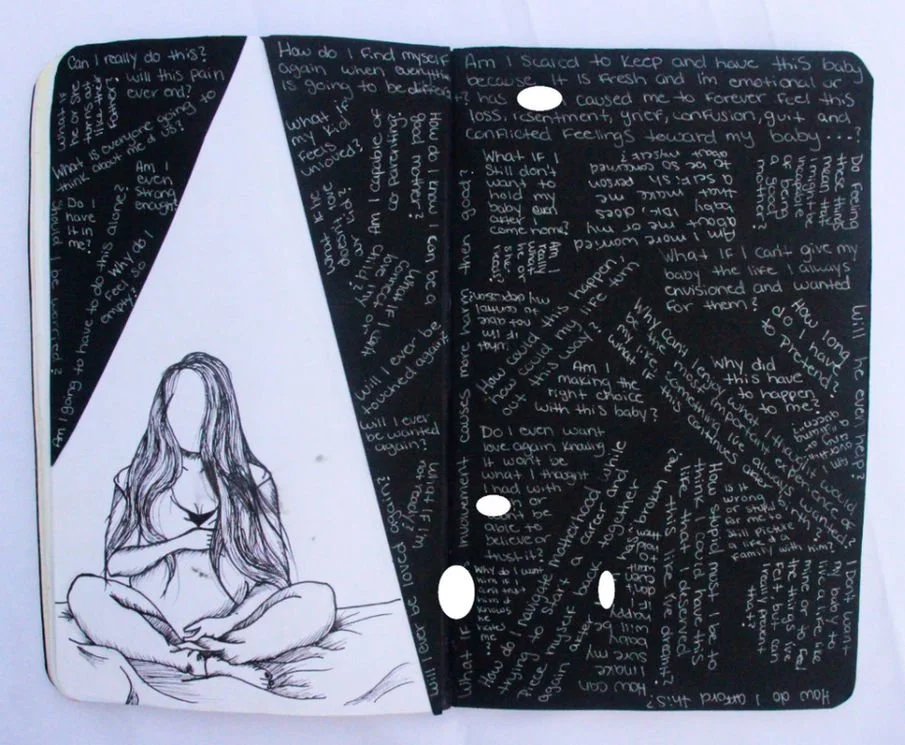
Title: Intrusive Thoughts: Intrusive Thoughts depicts a faceless figure sitting on a bed, holding a pregnant stomach, illuminated by a lone spotlight against a backdrop of deep blackness. The stark light isolates the figure, echoing the mental intensity and vulnerability of the moment. Covering the surrounding darkness are flowing handwritten lines in white pen, representing intrusive thoughts—fears, anxieties, and self-doubt—that spiral relentlessly. The text captures the weight of impending motherhood: the fear of failing, the pressure of responsibility, and the uncertainty of embarking on this journey as a single parent. The faceless figure emphasizes universality while remaining deeply personal, embodying the isolation and intensity of the inner experience. Through its contrast of light and dark, figure and text, the piece transforms mental turbulence into a visual meditation on anticipation, vulnerability, and the complex emotional terrain of pregnancy.
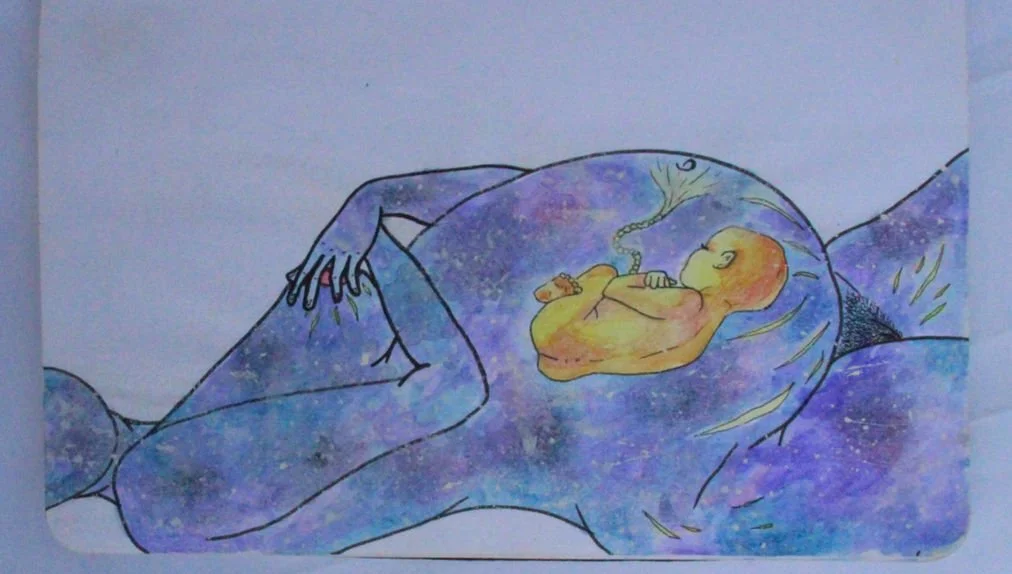
Title: Their Universe: Their Universe depicts a pregnant woman lying on her back, her body rendered in delicate contour lines. Within her stomach, a baby is visible, connected by an umbilical cord and painted in luminous watercolor, shining like a sun at the center of its own universe. The radiant child symbolizes the new purpose and motivation the mother found during a dark moment in her pregnancy—the awareness that she would soon become someone’s entire world and the weight, responsibility, and profound meaning that realization carried. The piece celebrates the transformative power of anticipation, portraying the child as both source of light and gravity, drawing focus and energy while illuminating the universe within the mother. Through the interplay of line and color, Their Universe captures the duality of vulnerability and empowerment, highlighting how motherhood reshapes identity, purpose
Public Concern
Graphite Pencils
Created during my college years (2018–2019), this work explores how the intimate becomes public through social commentary on beauty, sexual orientation, gender, and race. Rooted in daily interactions, I engaged participants in discussion-based processes, incorporating taped recordings to ensure collaboration and authenticity rather than speaking for them.
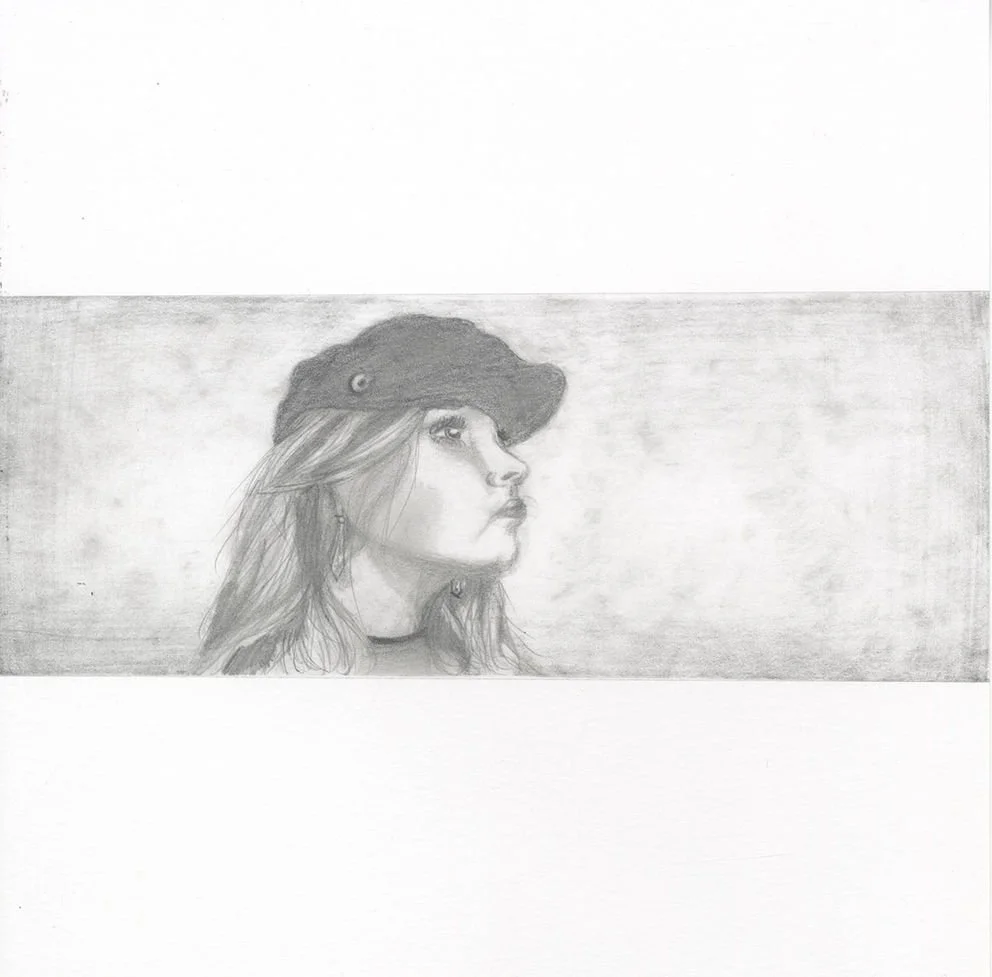
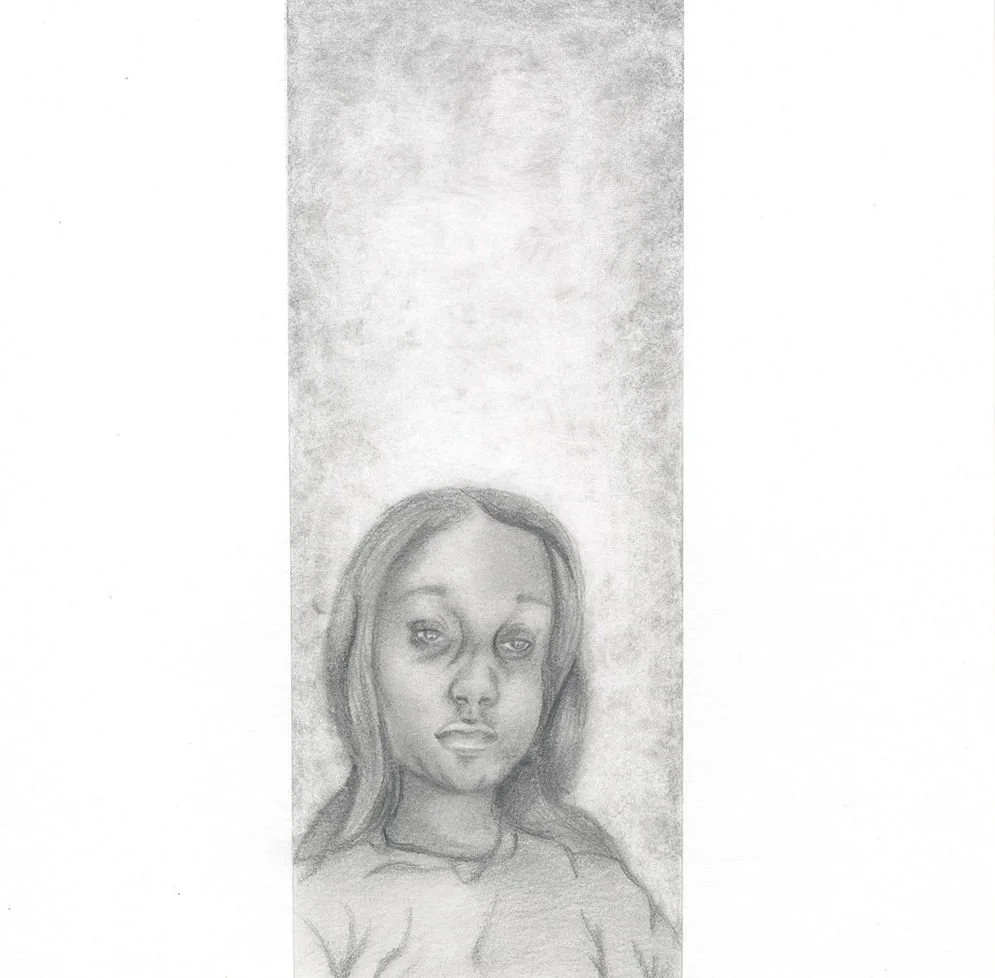
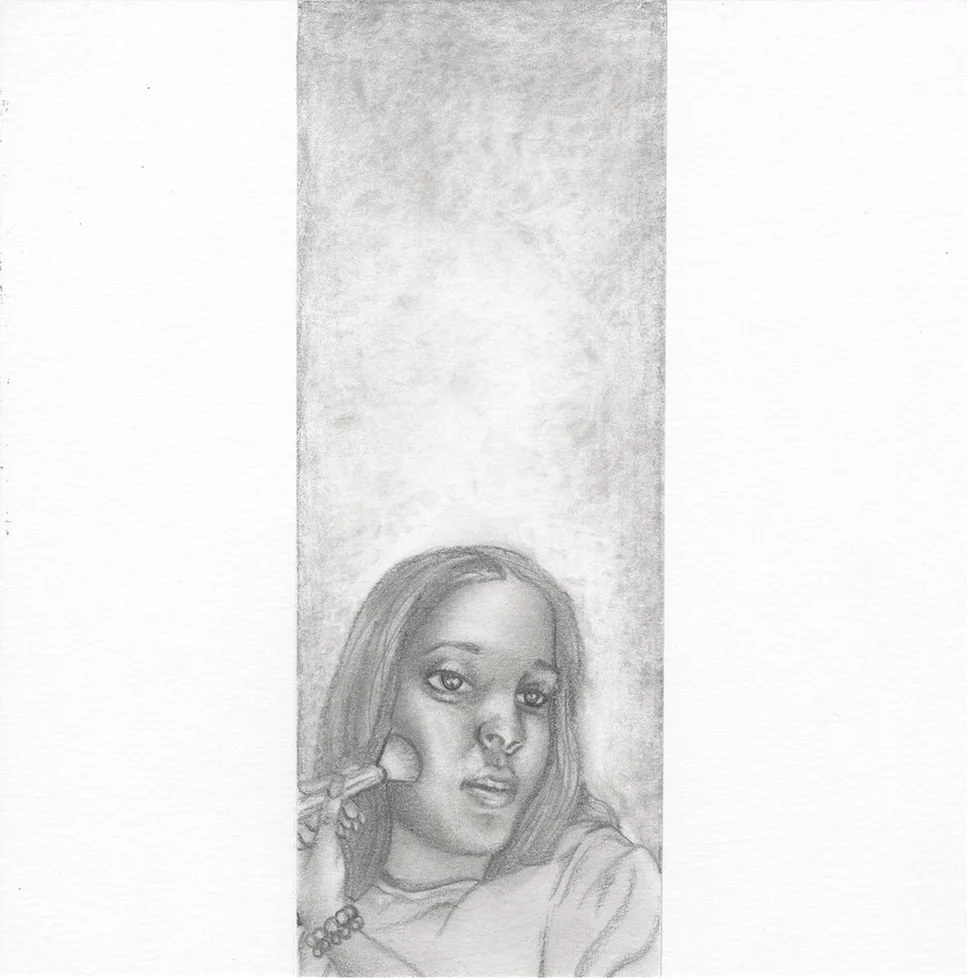
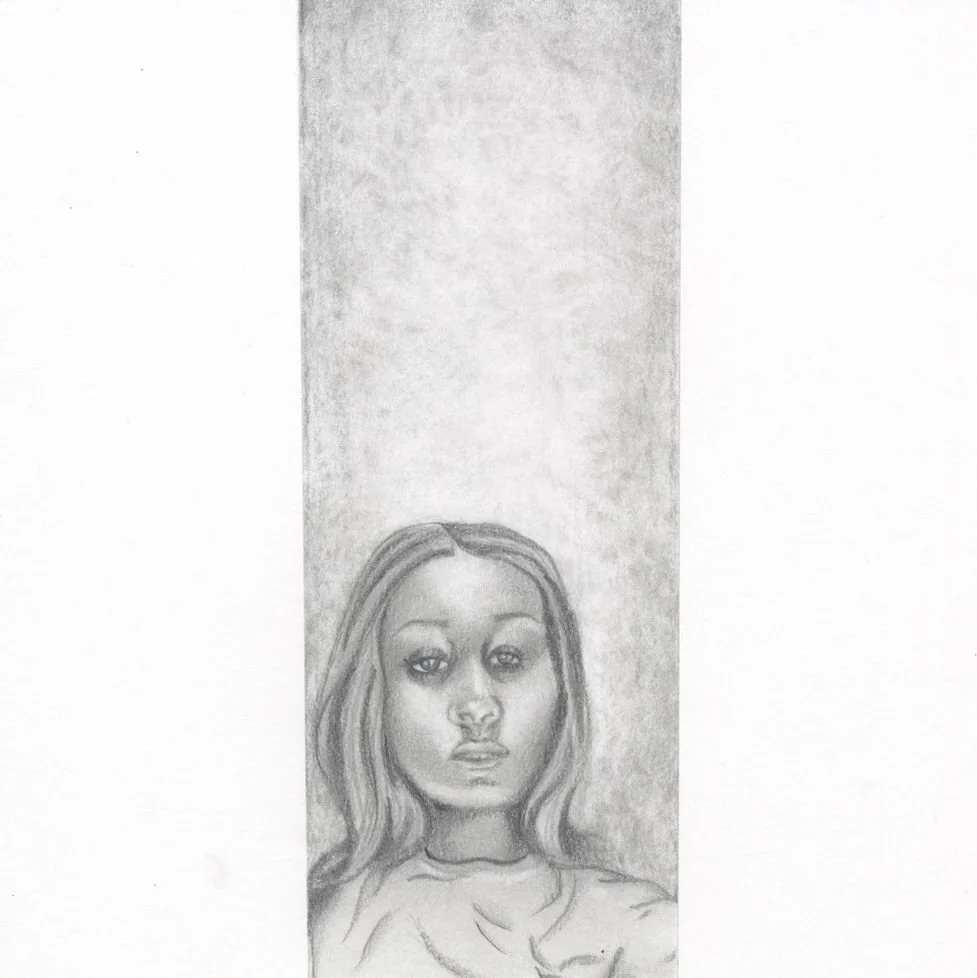
Influenced by John Coplans and Lorna Simpson, I employ unconventional portraiture, cropped imagery, and minimal backgrounds to emphasize captured gestures and moments. While my work spans multiple two-dimensional media, I used graphite pencil for this body of work, which allowed me to maintain a personal connection with each subject. Through careful observation, I translate both physical characteristics and lived experiences in a way that mirrors photography, retaining the intimacy and nuance of drawing while fostering reflection on shared social experiences.
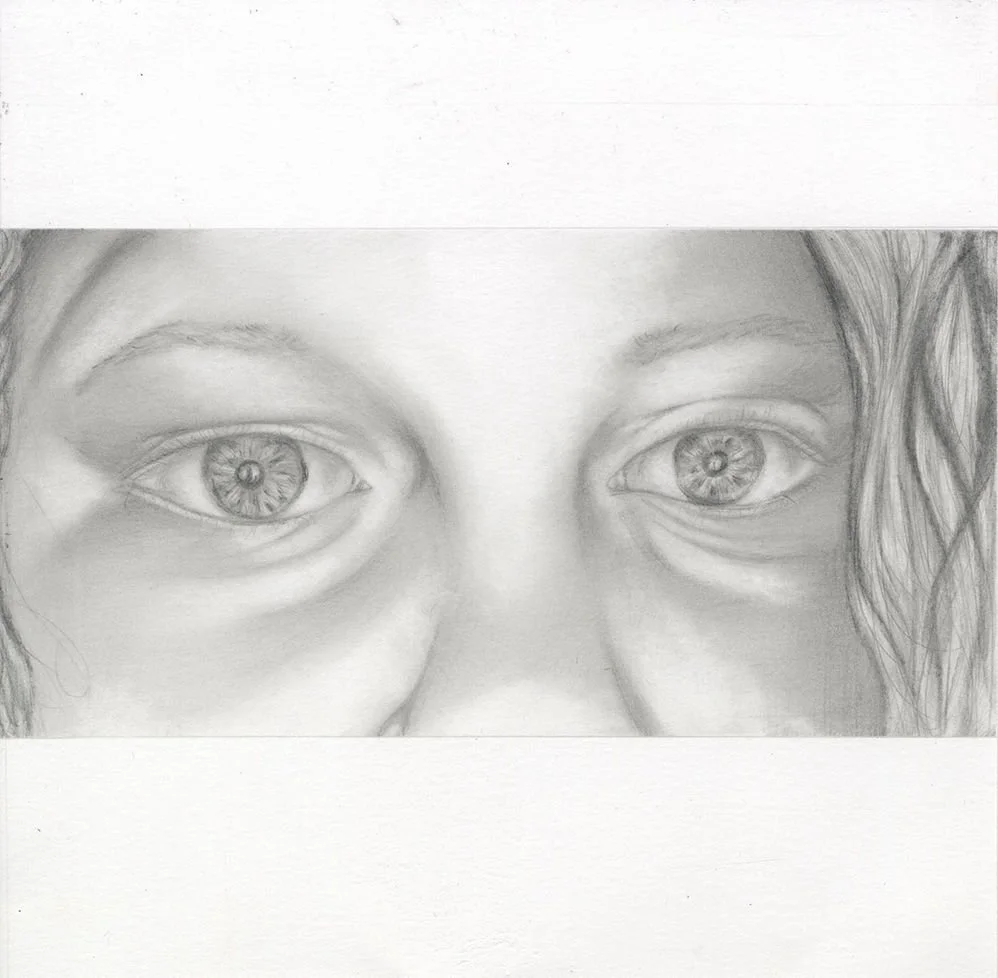
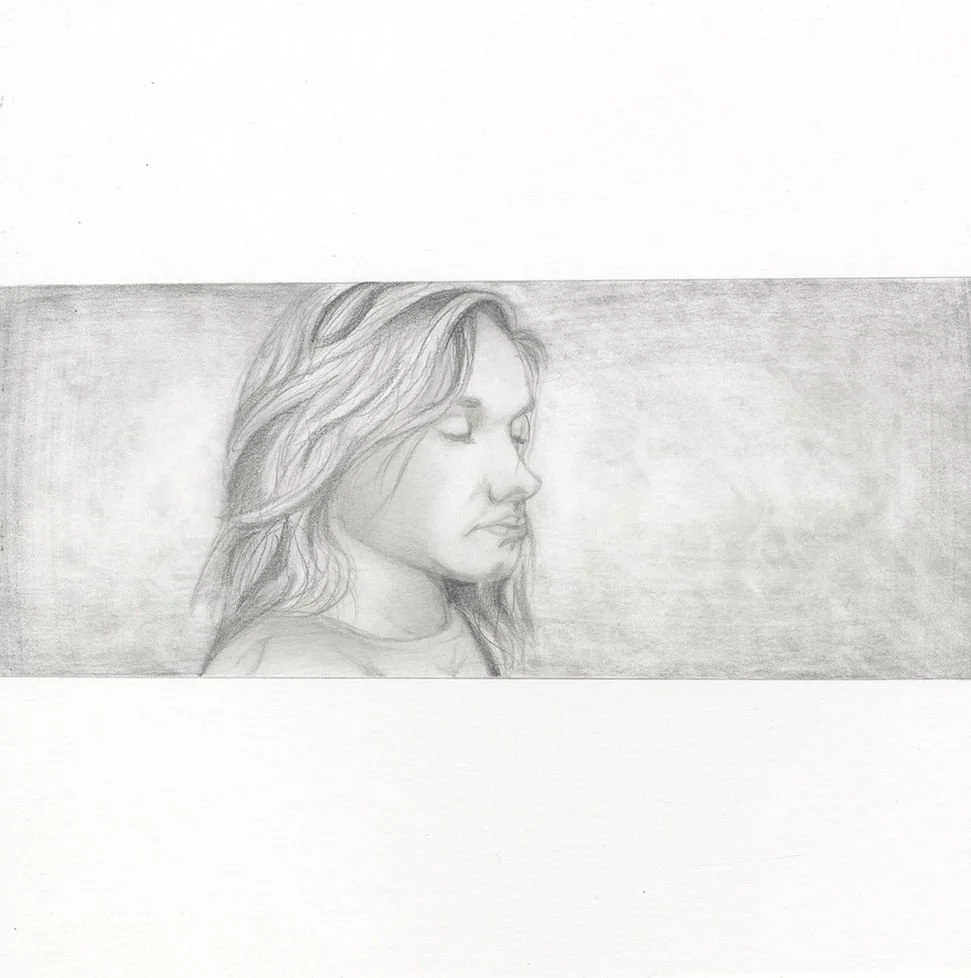
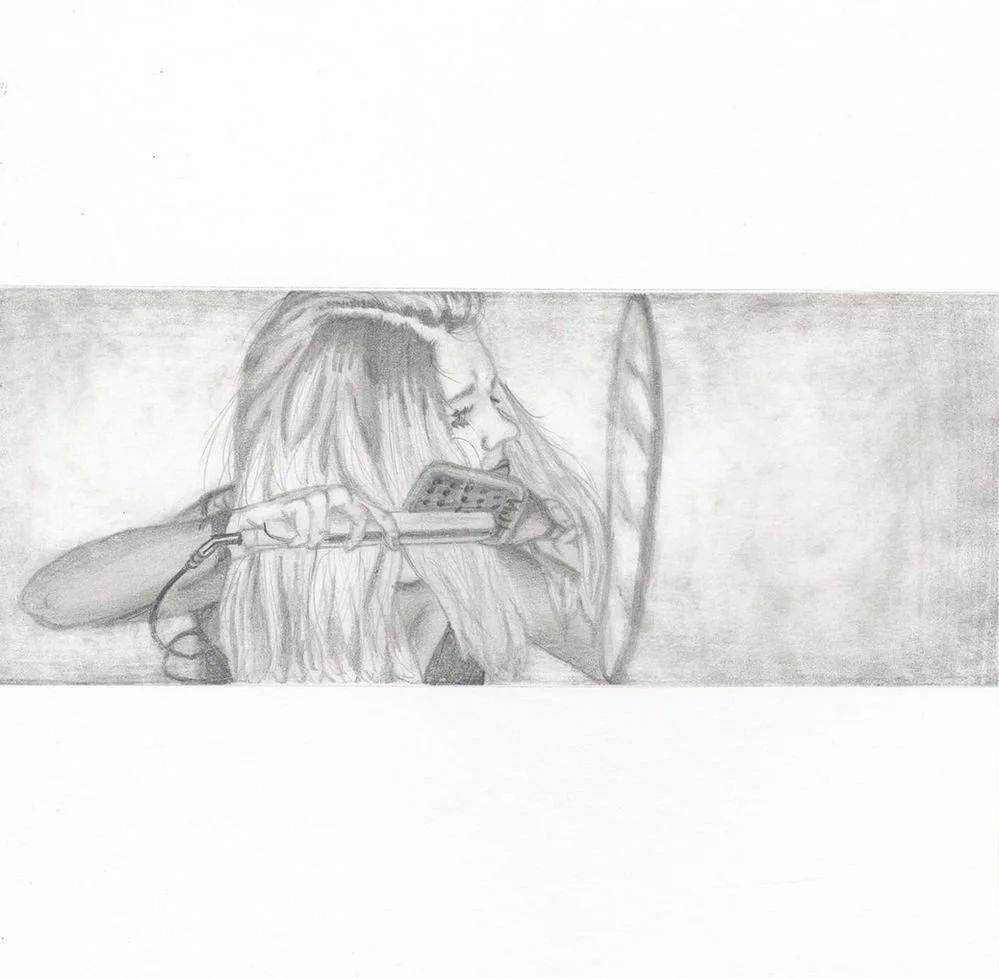
Ash Personal Reflection – Eyes and Lashes • Before: The artist is depicted with natural lashes, eyes reflecting the vulnerability of repeated comments about appearing ill or unattractive without makeup.
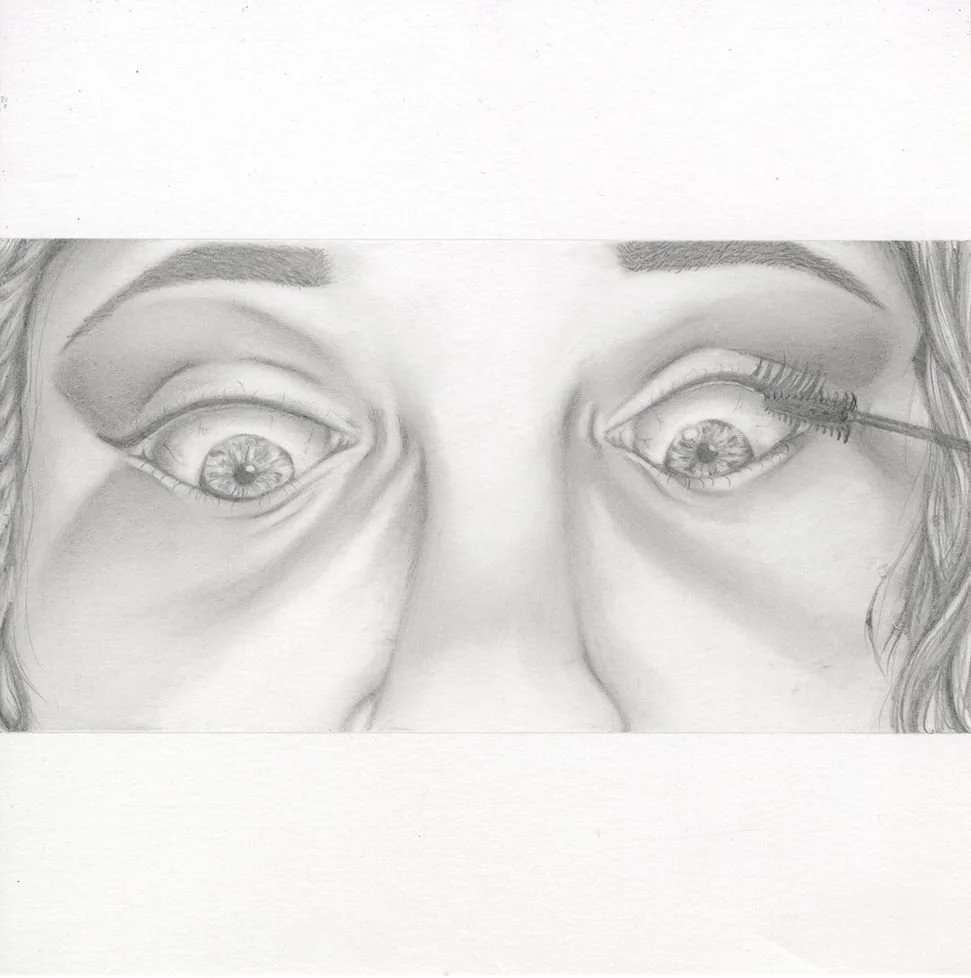
Ash: Personal Reflection – Eyes and Lashes • During: The second drawing captures the meticulous process of curling and enhancing the lashes, hands near the eyes, reflecting both care and the performative labor imposed by social judgment.
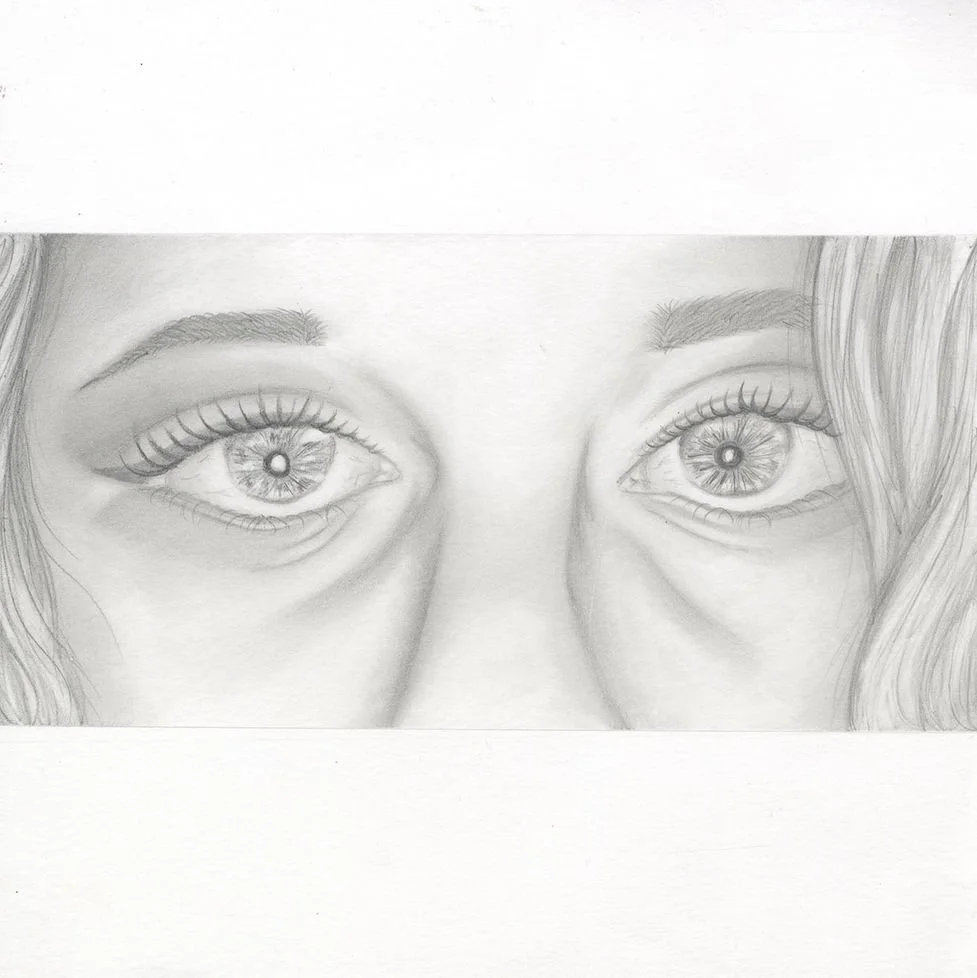
Ash: Personal Reflection – Eyes and Lashes • After: The final image presents the eyes fully made up, lashes lifted and emphasized. The subject’s gaze is more assertive, highlighting the interplay between societal pressures and personal agency in managing appearance.
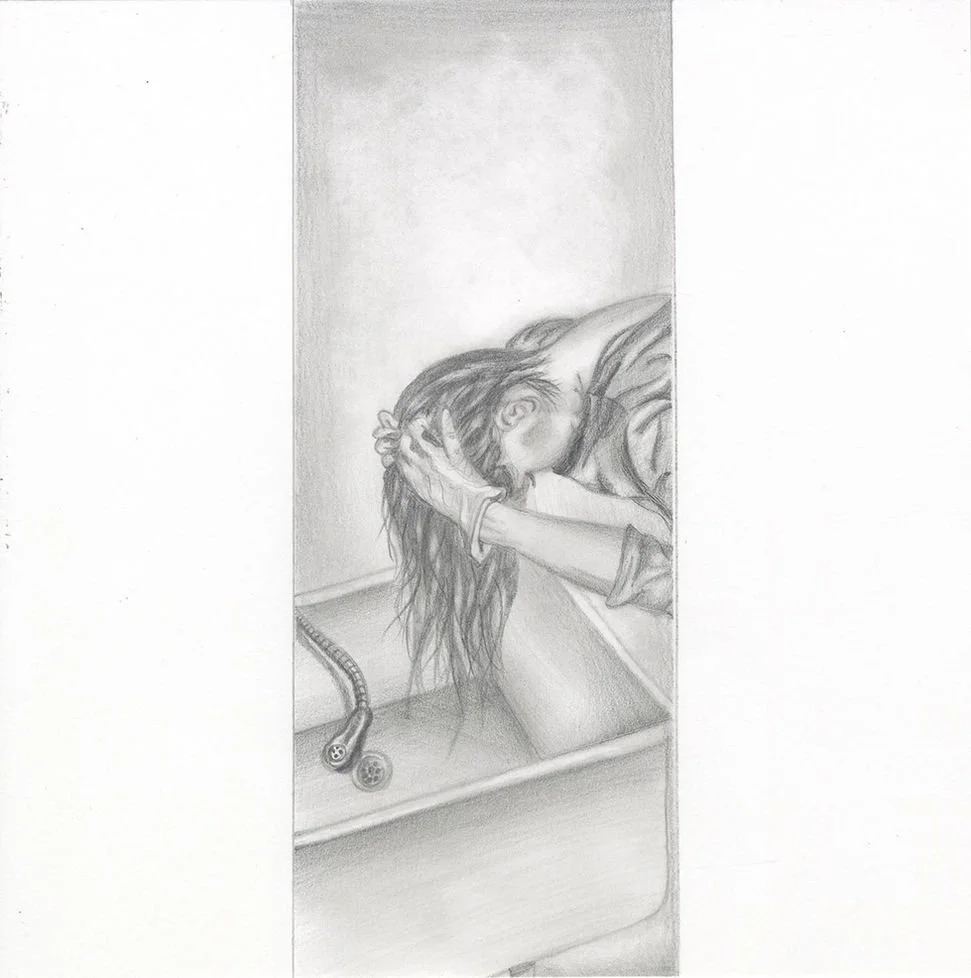
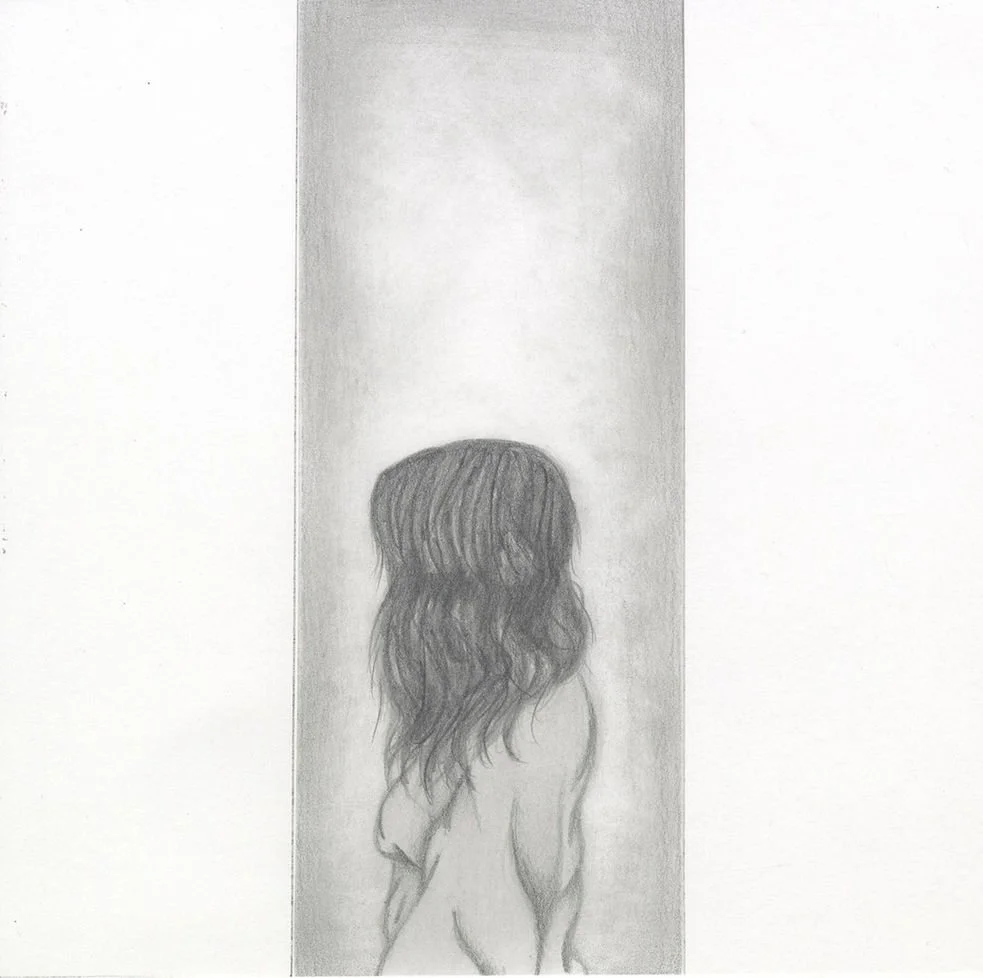
Terra: Hair and Aging • Before: The first image depicts the subject with natural hair, showing visible gray strands and signs of aging. Her posture suggest introspection, hinting at the pressures she feels from societal beauty standards regarding age and hair.
Terra: Hair and Aging • During: The second image captures her mid-process of dyeing her hair. The focus is on her hands in motion, reflecting the internalized pressure to alter her appearance to meet expectations.
Terra: Hair and Aging • After: The final image shows the subject with freshly dyed hair.
Cara: Style and Presentation • Before: The subject is depicted in casual attire, hair unstyled, and without accessories. There is an understated self-consciousness, highlighting the importance of style as a means of social perception.
Cara: Style and Presentation • During: She is actively styling her hair and preparing her outfit, including selecting a unique hat. The process conveys deliberation, ritual, and the care taken to present herself in a way she feels confident and visible.
Cara: Style and Presentation • After: The final drawing shows her fully styled, hat in place, and posture transformed. She appears poised and presentable, embodying confidence and the empowerment derived from expressing personal style within societal frameworks.
Destynee: Skin and Even Complexion • Before: She is shown without makeup, displaying natural skin texture and unevenness. Her expression communicates awareness of societal pressures to conceal perceived flaws.
Destynee: Skin and Even Complexion • During: She is applying foundation, hands delicately blending, with careful attention to achieving an even complexion. The drawing emphasizes ritualized gestures and focus, highlighting the intimate labor behind societal conformity.
Destynee: Skin and Even Complexion • After: The final image depicts her with foundation applied. Her posture is slightly lifted, and there is a subtle shift toward self-assurance, capturing the duality of performing beauty standards while reclaiming a moment of control.
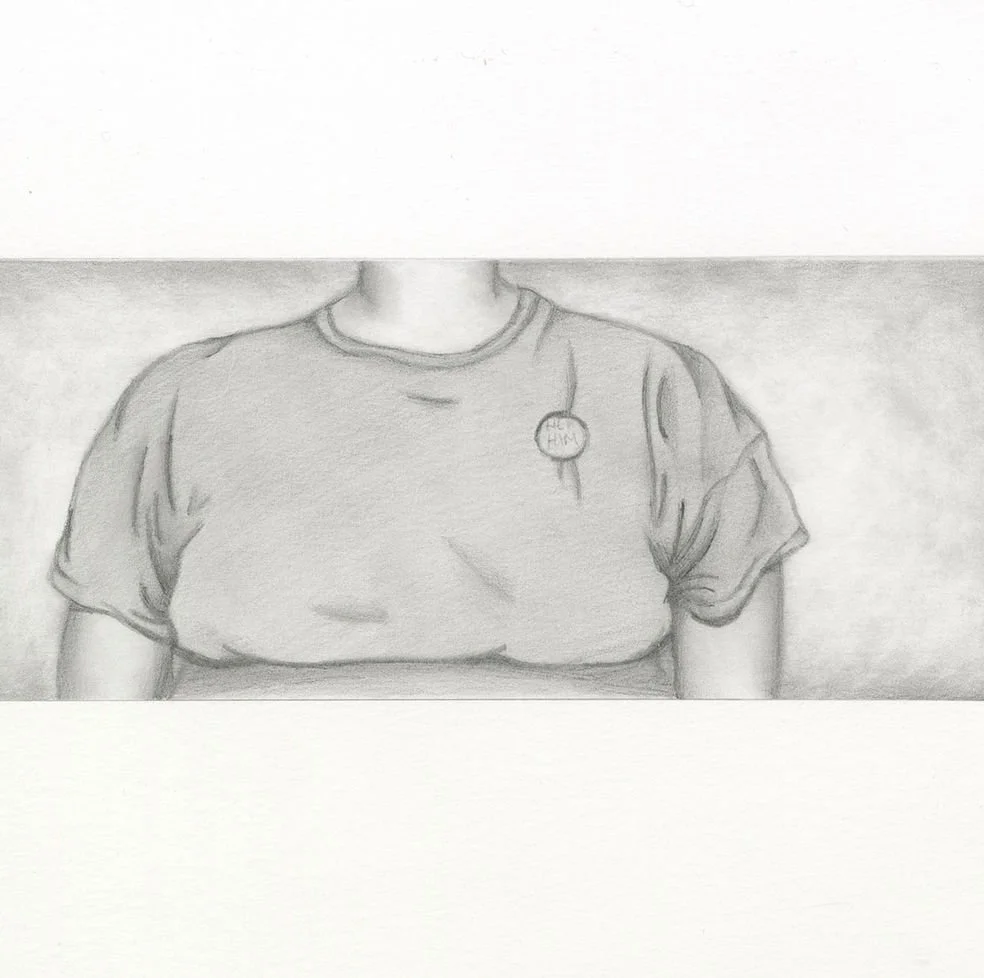
Damien: Navigating Sexualization (Trans Male Participant, He/Him) • Before: The subject, who identifies as trans male and uses he/him pronouns, appears in everyday clothing. His posture reflects awareness of being perceived as female and the sexualization that comes with it, showing subtle anxiety and discomfort.
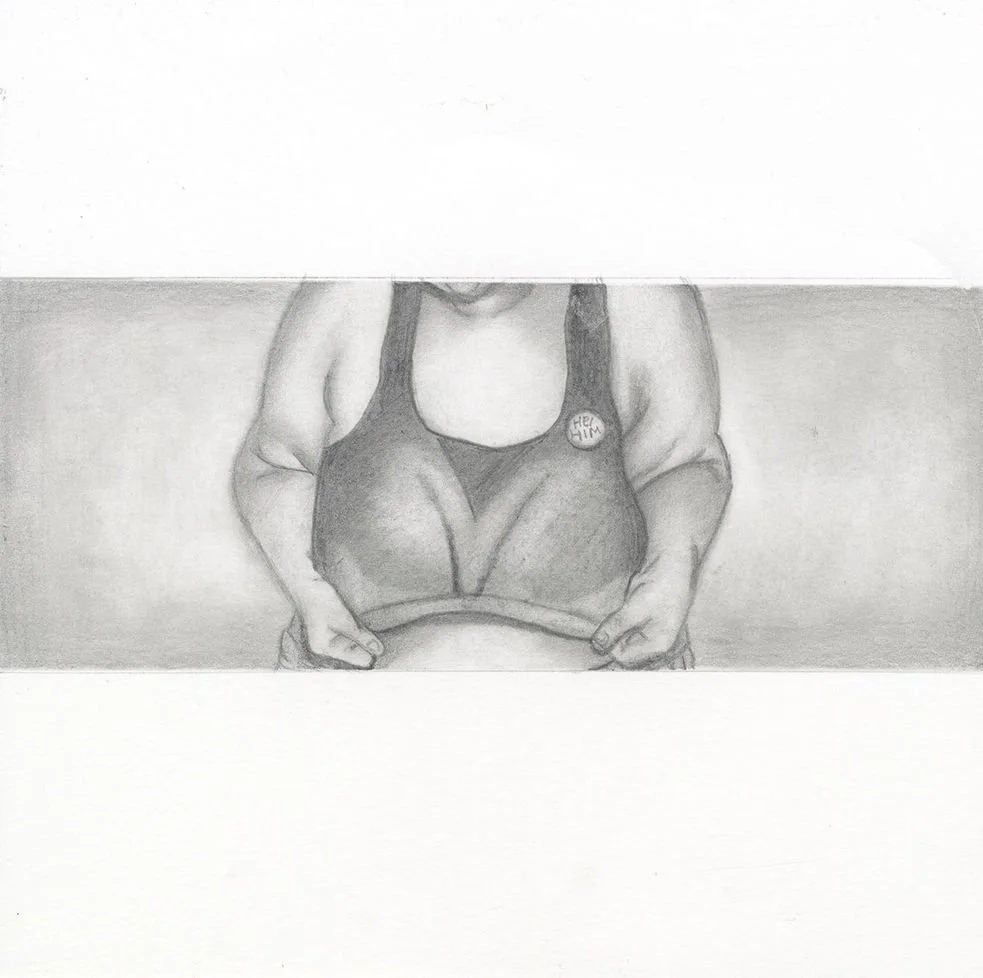
Damien: Navigating Sexualization (Trans Male Participant, He/Him) • During: The second image depicts him putting on a binder. The focus is on hands and the tension in the torso, illustrating the deliberate act of aligning his body with his gender identity and mitigating unwanted attention or assumptions from others.
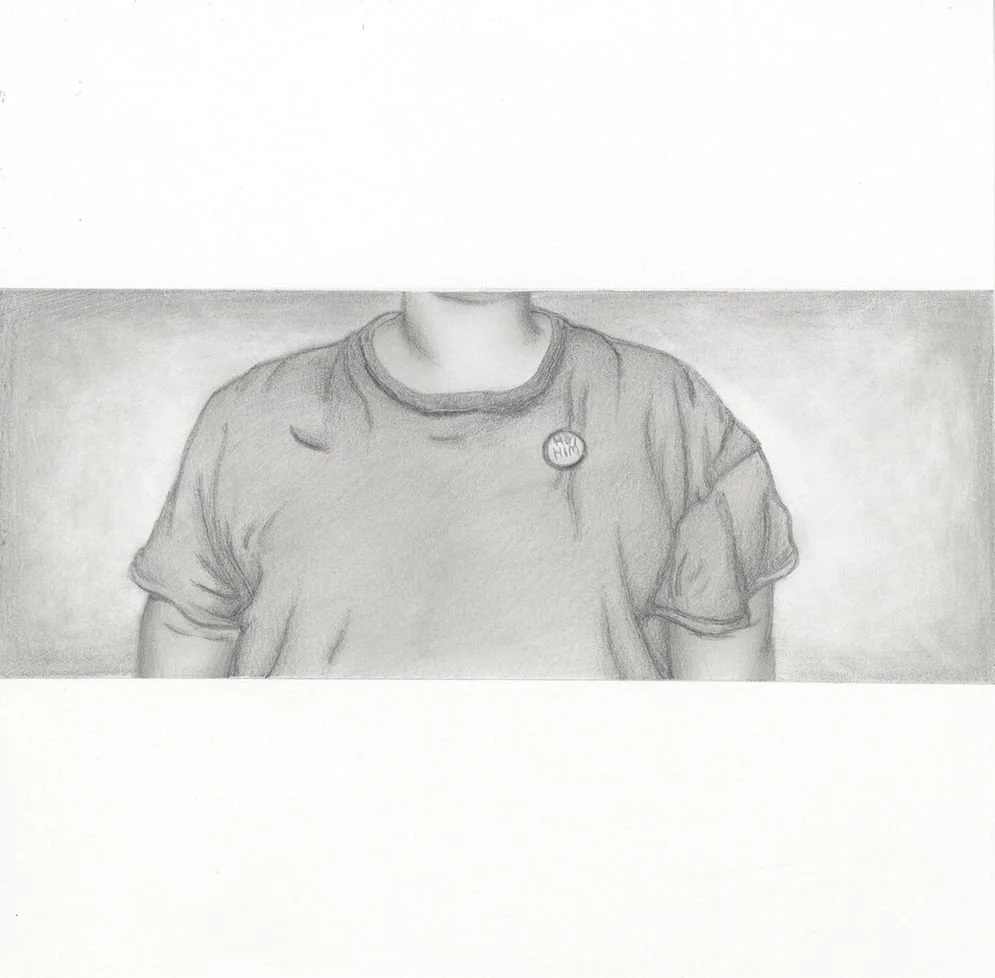
Damien: Navigating Sexualization (Trans Male Participant, He/Him) • After: The final image shows him bound, posture firm, and composed. The drawing communicates a negotiation between personal safety, self-expression, and the ongoing navigation of societal expectations, centering his experience as a trans male asserting control over his body and presentation while resisting sexualization.